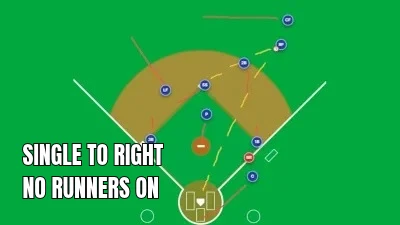
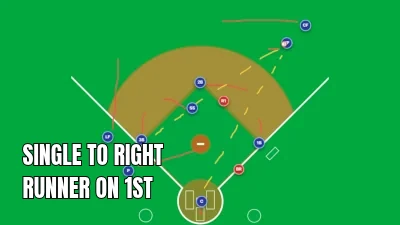
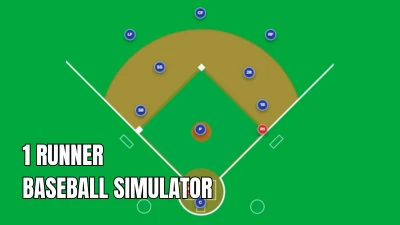
Single To Right Field With A Runner On First Base: Defensive Responsibilities
This article was mainly written for high school or older kids. Some advanced little league or travel teams may be able to use this as well. It really depends on the strength of your outfielders' arms.
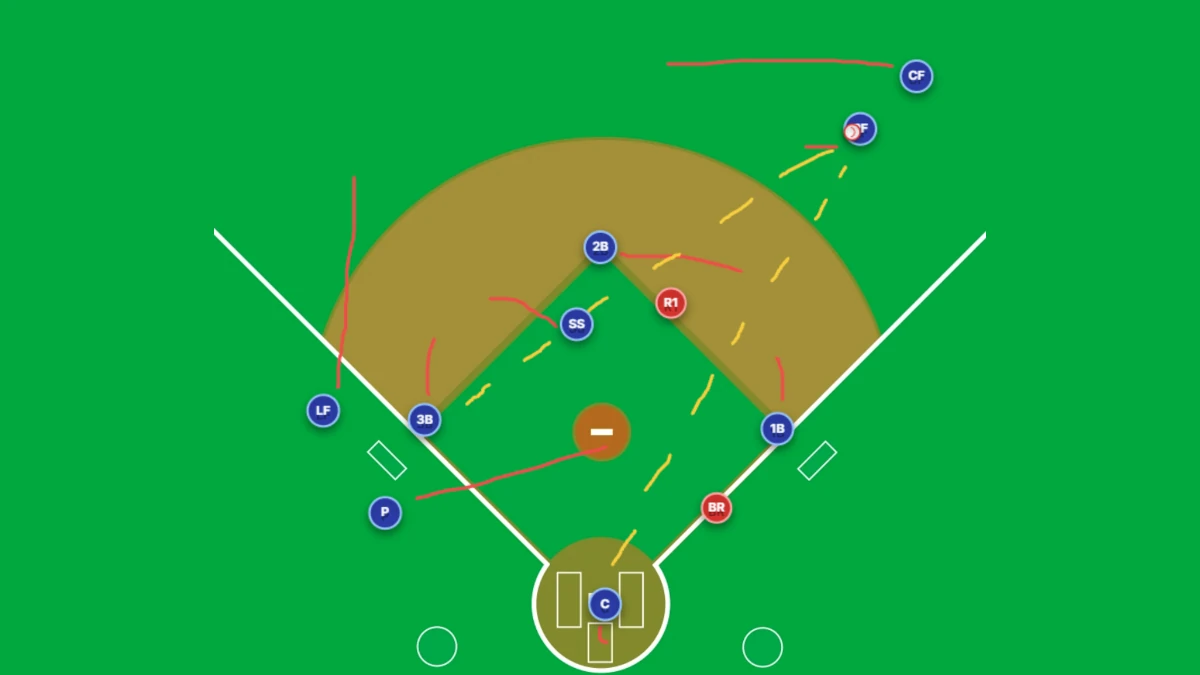
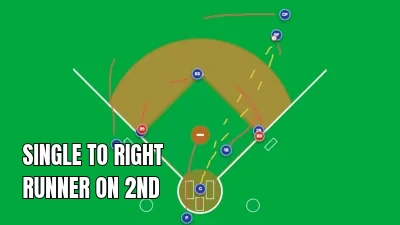
On a ball hit to right field with a runner on first base every player has a job to do. That job is the same no matter how many outs. All defenders should be moving to their positions prior to the ball touching grass or being caught.
As a general concept, on a ball hit to the outfield we are thinking two bases ahead of the lead runner. With the lead runner on first we are thinking third base.
Play Responsibilities
| Position | Primary Responsibility |
|---|---|
| Shortstop | Align as cut off between the ball and third base |
| First baseman | Cover first and make sure runner touches the bag |
| Second baseman | Cover second in case play develops to 2nd. |
| Third baseman | Cover base |
| Pitcher | Back up the third-base area |
| Catcher | Cover home plate |
| Left fielder | Provide backup behind 3rd base |
| Center fielder | Back up the right fielder based on the ball's direction |
| Right fielder | Fields ball and throws directly to third baseman |
Right Fielder (RF)
Call for the ball when able to make the play safely. The center fielder has priority over you.
Throw the ball directly to the third baseman on a line. Throw through the shortstop so he can cut the ball off if needed.
If the center fielder calls for the ball, then move behind where the ball will drop to get the ball on a hop or two.
Center Fielder (CF)
Start by moving towards the ball. Center fielder has pop up priority but if you can't get to the ball in time you should be moving more behind the right fielder to grab the ball on a hop or two.
Infield Positioning: Shortstop
You are the cut off from right field with a man on 1st. Should be positioned between the ball and third base on the infield grass.
If the runner is holding at second, the right fielder can throw the ball to you or the 2nd baseman.
If the runner is going for third the right fielder must field the ball and throw to third base, they are aiming low and straight toward third base.
You are letting the ball travel directly to third base with a few exceptions:
- If the ball doesn't have enough to carry to third base.
- If the ball is off target.
- If an infielder is saying "Cut 1", "Cut 2", "Cut 3", "Cut 4", you are catching the ball and throwing it to the respective base.
Cut Commands Guide
- Cut 1: Catch the ball and throws it to first base.
- Cut 2: Catch the ball and throws it to second base.
- Cut 3: Catch the ball and throws it to third base.
- Cut 4: Catch the ball and throws it to homeplate.
If the ball does have enough carry and no "Cut" command is called, you are getting out of the way and letting the ball travel to the third baseman.
Infield Positioning: 2nd Baseman
Cover second base but don't block the bag in case the runner is coming in.
If there is a play at second base, once you control the ball you are tagging the runner low (expecting him to slide).
Infield Positioning: 1st baseman
Cover first base. Verify the batter touches first base.
Be ready to field the ball (on a passed ball) or receive a throw, if the right fielder, and middle infielders can get the ball fast enough, especially if the runner "turns the corner".
Infield Positioning: 3rd baseman
Cover third base. Depending on the depth of the ball and the speed of the batter the play may be cut by the shortstop or thrown directly to you.
Pitcher
Run behind 3rd base, opposite of the left fielder in case of an over throw.
Be ready to join in a rundown situation, if the runner gets caught off a bag.
Catcher
Cover home plate in case the play develops into a play at the plate.
Left Fielder
Backup third base on the outfield side opposite the pitcher.
Not One-Size-Fits-All
Depending on the strength of your right fielders arm or the depth of the hit this may not work for you.
The outfielder may be required to throw to the cutoff man.
The outfielder should not "feel" they can make the throw. They should "know" they can make the throw. That means they'll need practice, to learn their limits.
Outcomes
| Outcome | What happens next |
|---|---|
| Fly ball caught | If the runner attempts to advance to second after tagging up, the right fielder can throw toward second base. |
| Ball drops safely | Runner on first may try for third. Outfielders field the ball, and the infield executes its cutoff and base-coverage assignments. |
| Ball rolls past the right fielder | Center fielder retrieves the ball, and the infield executes its cutoff and base-coverage assignments. |
| Throw to third is off target | Shortstop attempts to gain control. If shortstop misses, Pitcher and left fielder attempt to stop the ball and prevent the runner from advancing. |
| Base runner overruns third or gets caught between bases | Fielders communicate and execute a rundown, with other defenders covering the appropriate bases. |
Using Biomechanics & Modern Movement Science for Right Field Throws
As a coach, teach your right fielders to use pulldown throws rather than traditional high-arc long toss. The mechanics and intent are completely different.
Pulldown throws train players to produce game-speed arm action, efficient force transfer, and strong throws on a line. Long toss can build arm fitness, but pulldowns more closely match what happens during competition.
When a right fielder needs to make a strong throw, the goal is to create as much ball speed as possible while keeping the throw on a flat trajectory. The player should generate velocity through the ground and transfer that energy efficiently through the body into the baseball.
- Drive Force Toward the Target: Teach players to direct force horizontally instead of upward. The back leg should drive aggressively into the ground, creating momentum toward the target rather than lofting the ball into the air.
- Use a Strong Front-Side Block: When the front foot lands, the lead leg should firm up and act as a brace. A stable front side allows momentum from the lower body to transfer into rotational speed through the hips, trunk, and throwing arm. Energy that leaks into a collapsing front knee is energy that never reaches the baseball.
Prioritize the Mental Game & Player Autonomy
Great coaches do more than teach mechanics. They teach players how to handle failure, make adjustments, and trust themselves under pressure.
Make sure every player understands what they can currently do in a game. During practice, create situations that challenge those limits and encourage players when they set a personal best or execute a skill they could not perform before.
Give players a simple mental reset after mistakes. A good rule is the 30-second flush. Let them acknowledge the mistake, learn from it, and move on.
If a player gives maximum effort and comes up short, do not punish them. Correct the decision or execution, but never make them afraid to compete aggressively.
After an error, players should hear and repeat:
"You'll get the next one."
Players who fear their coach's reaction often play tight and hesitate. Players who know they are supported will recover faster and learn more from their mistakes.
How to Teach the Play
- Start by drawing the play on a whiteboard or sharing this page with the team so every player understands their responsibility.
- Put players at their game positions and hit balls to right field. Watch how the entire defense reacts, not just the outfielder.
- Correct major mistakes first. Once positioning and assignments are consistent, focus on the smaller details.
- Finish with pulldown throws for the right fielders and shortstops to reinforce game-speed throwing mechanics.
Practice Drill: Line Drive to Right Field
Don't just practice perfect reps. Practice mistakes as well. The best defenses know how to recover when something goes wrong.
Occasionally instruct a player ahead of time to make a controlled mistake, such as misplaying the ball or making an off-line throw.
Coach the team's response regardless of the outcome. Players should know exactly where to go and what to do when the play breaks down.
- Focus on communication, cutoff responsibilities, backup positioning, and urgency.
- Position all nine defensive players on the field with a runner on 1st.
- Hit line drives to right field and have players execute their assignments. Repeat until everyone consistently gets into the correct position.
- Introduce mistakes such as a missed ball, an overthrow, or a delayed relay. Continue until every player understands their responsibility when the original play fails.
More Details On How To Use the Play Simulator
Need complete step-by-step instructions on how to use the play simulator? View Full Documentation →