Ground Ball to Shortstop (No Runners On): Defensive Responsibilities
This article was mainly written for high school or older kids. Some advanced little league or travel teams may be able to use this as well. It really depends on the arm strength and speed of your infielders.
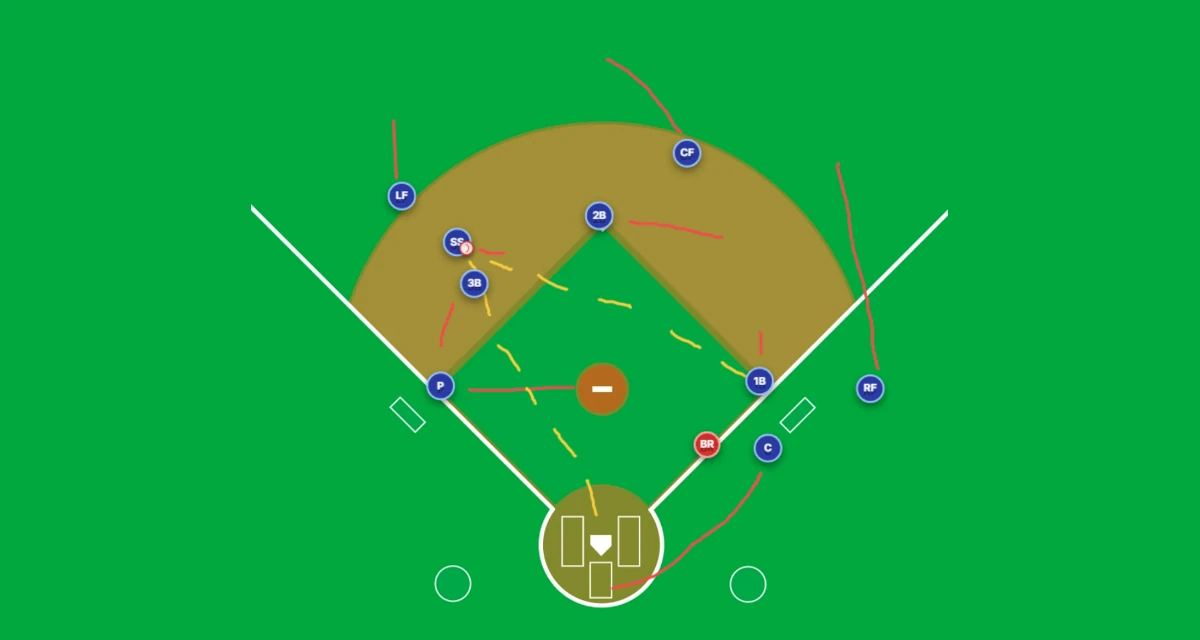
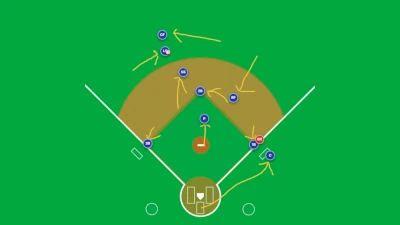
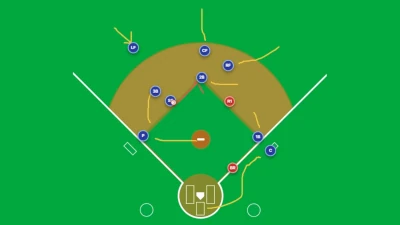
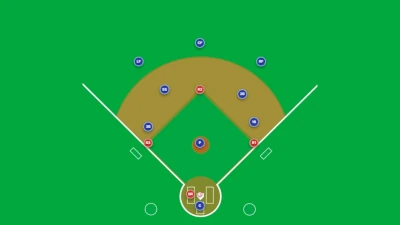
On a ground ball to the shortstop with no base runners on, every player has a job to do. That job is the same no matter how many outs. All defenders should be moving to their positions prior to the ball being fielded or thrown.
As a general rule, on a ground ball in the infield with no runners on, our primary focus is getting the force out at first base while keeping all backup responsibilities covered in case of an error or overthrow.
Shortstop (SS)
The shortstop must field the ball cleanly on a hop, secure a firm grip, and make a strong, accurate throw to the first baseman.
If the ball is hit to the shortstop's left or right, they must read the spin, range over quickly, break their momentum, and set their feet toward first base before releasing the throw.
Infield Positioning: 1st Baseman
The first baseman immediately moves to cover first base, giving the shortstop a clear target.
The first baseman must stretch toward the incoming throw while keeping a foot anchored on the bag, securing the ball for the out before the runner touches the base.
Infield Positioning: 2nd Baseman
The second baseman moves toward second base to cover the bag in case the grounder takes a bad hop, deflection, or the play turns into a throw to second base.
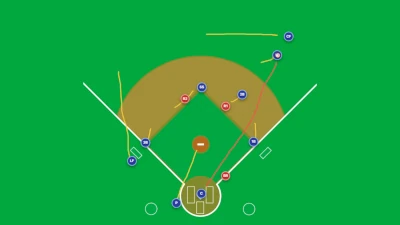
If the ball passes the shortstop into the outfield, the second baseman becomes the primary coverage at second base.
Infield Positioning: 3rd Baseman
The third baseman will typically attempt to field the ball too or become a backup in case the shortstop misses the ball. 3rd baseman does NOT cover their bag in this scenario.
Remember: If the shortstop misses the ball they may be in a starfish position on the ground after attempting a diving stop. The thirdbasman, still being on his feet, will get to a passed ball faster.
Outfield Positioning: Left Fielder (LF) & Center Fielder (CF)
The left fielder break forward to back up the shortstop too. If the ball completly misses the shortstop, it may have too much force for the third baseman to get their on time.
Outfield Positioning: Center Fielder (CF)
The center fielder will either break to back up the shortstop or move to backup a throw to second base depending on where the ball is hit.
If the ball is hit closer to second base, the center fielder will become the backup instead of the left fielder.
If the ball is hit closer to third base, the center fielder can move to back up a throw to second base in case the runner is attempting to take an extra bag.
Pitcher
On a ground ball to the left side of the infield, the pitcher breaks toward the third base line to back up the first baseman in case of an overthrow.
The pitcher should also be ready to cover first base if the first baseman is pulled off the bag to field an off-target throw.
As an alternative, the pitcher may run over and cover third base but that is less helpful since there is no one else on base.
Catcher
The catcher hustles down the first base line behind the batter-runner to provide a secondary backup behind first base in case the throw escapes into foul territory.
Right Fielder
The right fielder hustles in toward foul territory behind first base as an additional deep backup for any wide or high throws from the shortstop.
Not One-Size-Fits-All
Depending on the speed of the batter and the strength of your shortstop's arm, mechanics may adjust.
The shortstop should not "feel" they can rush a wild throw. They should "know" their footwork and timing to make an accurate throw. That means they'll need practice to master field-and-throw rhythms.
Using Biomechanics & Modern Movement Science For Infield Throws
The shortstop must learn efficient arm slot transitions and rapid lead-leg block mechanics.
Infield throws require fast transfer times and clean directional force vectors without wasting strides or momentum.
- Force Vector Orientation: On an infield grounder, the fielder shifts their force vector horizontally toward first base. The athlete must drive off the trailing leg directly along the throwing target line.
- Lead-Leg Dynamic Stabilization (The Block): Upon plant, the lead leg acts as a brace. Kinetic energy from linear momentum is converted into rotational velocity through the hips and trunk, maximizing throw velocity on a tight line.
Prioritizes the Mental Game & Autonomy
Great coaches don't just teach physical mechanics; they teach young players how to self-correct and stay calm under pressure.
Make sure your players know what they can and can't do in games. Constantly put light pressure in practices to push those limits and be sure to congratulate and reinforce players when they increase their best or hit a new personal record.
Give your players a 30-second reset on errors. Do not punish a player for screwing up when they gave it their all. Instead, encourage them and give them this mental piece of advice.
On any errors they should hear and think "You'll get the next one." One of the worst things for a player is being punished for giving it 100% effort or being mocked or teased for a bad play.
How To Teach The Play
- Start by whiteboarding out the play or sharing this webpage with every member of your team.
- Move into drills where every player is at their respective positions. Hit ground balls to the shortstop and watch everyone move into backup and coverage positions.
- Coach any larger errors before moving into smaller areas of improvement.
- Move into quick-transfer throw drills for all infielders.
More Details On How To Use the Play Simulator
Need complete step-by-step instructions on how to use the play simulator? View Full Documentation →