For many young baseball players, few changes feel as dramatic as moving from a USSSA bat to a BBCOR drop 3 bat. One season you're driving balls deep with a lightweight, high-performance USSSA bat, and the next you're stepping into high school baseball holding a heavier bat that feels completely different. It's a transition that frustrates countless players and parents, but it doesn't have to.
The truth is that most hitters struggle with BBCOR initially because they expect the same swing, timing, and results they experienced with USSSA bats. BBCOR bats are designed differently and reward a different approach. The players who make the easiest transition are not necessarily the strongest athletes. They are the ones who prepare correctly and understand what changes are coming.
If your player is approaching high school baseball, entering competitive 14U tournaments, or simply preparing for the next level, this guide will show exactly how to make the transition from USSSA to BBCOR as smoothly as possible.
Understanding the Difference Between USSSA and BBCOR
Before discussing training methods, it's important to understand why BBCOR feels so different.
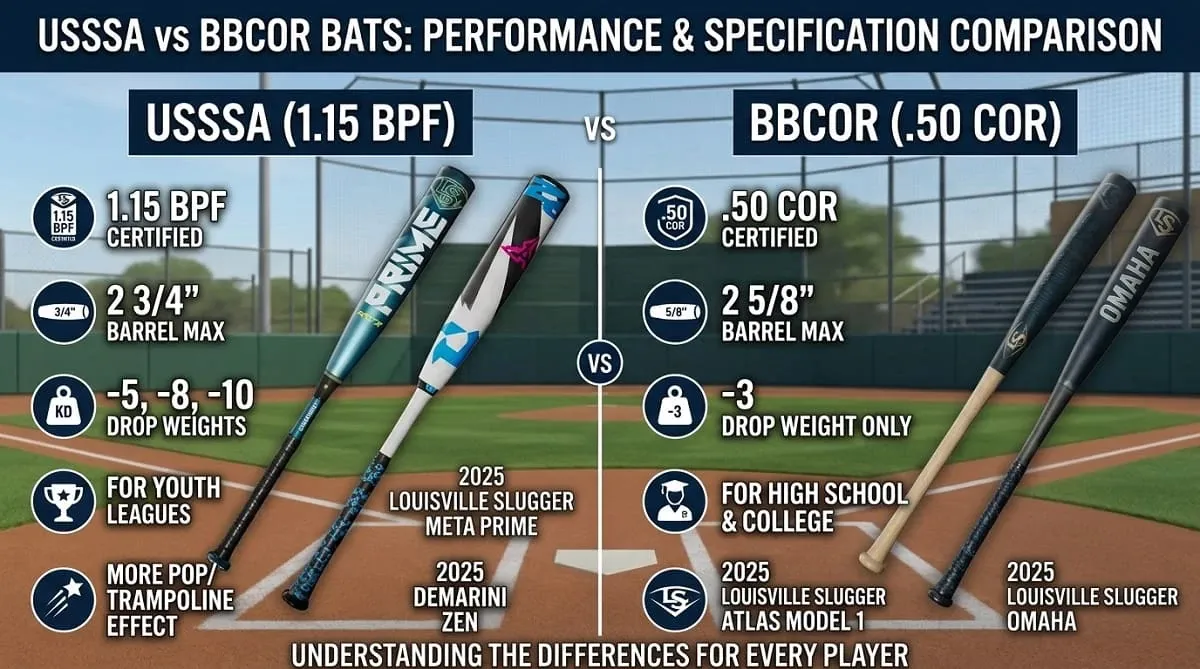
USSSA bats are specifically designed for youth baseball and feature a higher-performance barrel with more trampoline effect. The result is increased exit velocity and more forgiveness on mishits. They are also commonly available in lighter drop weights such as -5, -8, and -10, making them easier for younger players to swing quickly.
BBCOR bats, on the other hand, are regulated to a .50 BBCOR standard. The certification limits trampoline effect and makes the bat perform much closer to a traditional wood bat. Every BBCOR bat must also be a drop 3 (-3), meaning the bat weighs three ounces less than its length in inches. A 33-inch BBCOR bat must weigh 30 ounces.
Additionally, BBCOR bats have a maximum barrel diameter of 2⅝ inches, compared to the 2¾-inch barrels often found on USSSA bats. That smaller barrel profile and reduced trampoline effect create a more demanding hitting experience.
The end result is simple:
- Heavier swing weight
- Less forgiveness on mishits
- Lower exit velocity from poor contact
- Increased importance of proper mechanics
- Greater emphasis on strength and bat speed
This isn't a flaw. It's by design. BBCOR standards were created to reduce exit velocity and bring the aluminum and composite bat experience closer to wood bats used at higher levels of baseball.
Why Players Often Struggle at First
Many players blame the bat when they first switch to BBCOR.
They notice fewer home runs.
Hard-hit balls suddenly become routine fly balls.
Mishits that used to sneak through the infield become easy outs.
The issue usually isn't the bat. It's the adjustment period.
Players who spend years using highly responsive USSSA bats often develop habits that BBCOR quickly exposes. Because BBCOR provides less assistance from the barrel, hitters must consistently find the sweet spot and maintain proper mechanics throughout the swing.
When players fail to adjust, they commonly experience:
- Late swings
- Reduced bat speed
- Poor barrel control
- Loss of confidence
- Over-swinging
Fortunately, every one of these issues can be addressed through proper preparation.
One other note: try to pick the best bat before transitioning; that way, you aren't buying multiple year after year.
Start Earlier Than You Think
One of the biggest mistakes families make is waiting until the first high school practice before introducing a BBCOR bat.
Most experts recommend beginning the transition between ages 13 and 14, depending on league requirements, player maturity, strength level, and competitive goals. Many high school leagues require BBCOR, and some advanced travel divisions are introducing BBCOR requirements even earlier.
That doesn't mean players should completely abandon their USSSA bat overnight.
Instead, gradually introduce BBCOR into training while continuing to compete with the legal bat for their current league.
A simple approach might look like this:
Month 1
- 80% USSSA swings
- 20% BBCOR swings
Month 2
- 60% USSSA swings
- 40% BBCOR swings
Month 3
- 50% USSSA swings
- 50% BBCOR swings
Final Months Before Transition
- Primarily BBCOR training
- Occasional USSSA game usage if permitted
This gradual process helps players adapt physically and mentally without sacrificing performance during the season.
Focus on Strength Before Swinging Harder
Many young hitters respond to a heavier BBCOR bat by trying to swing harder.
This is usually the wrong solution.
When hitters attempt to generate more bat speed through effort alone, they often develop mechanical problems such as:
- Flying open
- Casting hands
- Lunging forward
- Losing balance
- Pulling off pitches
Instead, focus on increasing actual strength and bat control.
The transition to BBCOR becomes dramatically easier when players improve:
Forearm Strength
Strong forearms help control the barrel through the zone and maintain bat speed throughout the swing.
Core Strength
The baseball swing generates power from the hips and torso, not the arms.
Rotational Power
Medicine-ball exercises, rotational throws, and resisted movement training can improve explosive power that directly transfers to hitting.
Grip Strength
A stronger grip can improve barrel control and help hitters maintain consistent contact.
The stronger the athlete becomes, the less noticeable the heavier BBCOR bat feels.
Don't Chase Home Runs
One lesson many players learn quickly after switching to BBCOR is that chasing home runs usually backfires.
With USSSA bats, hitters can sometimes get away with imperfect mechanics and still drive the baseball. The enhanced barrel performance helps create extra carry and exit velocity.
BBCOR rewards a different approach.
The best BBCOR hitters focus on:
- Line drives
- Gap-to-gap power
- Hard contact
- Consistent barrel accuracy
Ironically, once hitters stop trying to hit home runs and begin focusing on quality contact, the power eventually returns. Which is one of the reasons it's so important to pick the right sized BBCOR bat.
High school and college coaches consistently emphasize this principle because hard line drives translate to every level of baseball.
Train With Intentional Bat Progressions
One highly effective transition strategy is using multiple bat weights during practice.
Many coaches recommend a progression involving:
- Standard BBCOR bat
- Slightly heavier training bat
- Lighter training bat
This approach helps players improve:
- Swing efficiency
- Barrel awareness
- Bat speed
- Timing
The goal is not to swing the heaviest bat possible. The goal is to help the body adapt to different swing loads while maintaining proper mechanics.
When players return to their standard BBCOR bat, it often feels more manageable and controllable.
Improve Swing Efficiency
BBCOR quickly reveals inefficiencies in a swing.
With lighter USSSA bats, some players can get away with extra movement before launching the barrel. Once they pick up a BBCOR bat, those inefficiencies become obvious.
Common issues include:
Long Hand Paths
The longer the bat takes to reach the hitting zone, the harder it becomes to handle velocity.
Excessive Load Movements
Large leg kicks and body movements can disrupt timing.
Early Hand Separation
Premature movement often causes hitters to lose sequencing.
Pull-Side Dominance
Players who rely solely on pulling the baseball often struggle against quality pitching.
A compact, efficient swing becomes increasingly important with BBCOR.
The hitters who transition most successfully usually simplify their mechanics rather than adding complexity.
Expect an Initial Drop in Performance
This may be the most important piece of advice in the entire process.
Performance often declines temporarily.
That's normal.
Many players experience:
- Lower batting averages
- Reduced exit velocity
- Fewer extra-base hits
- Less confidence
This decline does not mean the player is regressing.
Instead, it's a natural adaptation period as the athlete learns how to optimize swing mechanics with a different tool.
Players and parents must understand that short-term struggles often lead to long-term improvement.
Remaining patient during this stage is crucial.
Use Tee Work More Than You Think
When transitioning to BBCOR, tee work becomes incredibly valuable.
Many players underestimate how much improvement can occur from simple tee drills.
Benefits include:
- Developing barrel accuracy
- Reinforcing proper mechanics
- Building confidence
- Creating consistent contact points
Effective BBCOR tee drills include:
Middle Tee Drill
Focus on driving line drives through the middle of the field.
Opposite-Field Tee Drill
Builds barrel control and prevents pull-happy tendencies.
High Tee Drill
Encourages staying on top of the baseball.
Low Tee Drill
Promotes proper posture and bat path.
Fifteen minutes of focused tee work several times per week can dramatically accelerate the adjustment process.
Learn to Love the Sweet Spot
BBCOR bats reward precision.
While USSSA bats provide a larger margin for error through increased trampoline effect, BBCOR hitters must consistently square up the baseball.
This means developing:
- Better pitch recognition
- Improved timing
- Superior barrel accuracy
Instead of measuring every session by distance hit, begin measuring:
- Line-drive percentage
- Hard-contact rate
- Consistent barrel strikes
Players who learn to prioritize quality contact often become far better hitters than they were during their USSSA years.
Face More Velocity During Practice
One challenge of moving into high school baseball is facing faster pitching.
The heavier bat is only one part of the adjustment.
Pitching velocities also increase significantly.
Players should gradually expose themselves to:
- Faster batting practice
- Pitching machines
- Live at-bats against older players
- Velocity-specific drills
This helps synchronize the timing adjustments required for BBCOR.
Because BBCOR bats are heavier and less forgiving, timing becomes even more critical against higher-level pitching.
Consider the Right BBCOR Bat
Not all BBCOR bats feel the same.
Although all BBCOR bats must meet the same certification standards, different models offer different swing characteristics.
Players transitioning from USSSA often prefer:
Balanced BBCOR Bats
These feel lighter during the swing and are generally easier to control.
Composite BBCOR Bats
Many players appreciate the smoother feel and reduced vibration associated with composite construction.
Hybrid BBCOR Bats
These provide a blend of barrel performance and swing comfort.
Finding the correct model won't eliminate the transition, but it can make the process more comfortable.
Confidence Matters More Than Most Players Realize
A major theme from players who successfully transition to BBCOR is confidence.
Many athletes become discouraged after losing some immediate performance.
However, confidence influences:
- Swing decisions
- Aggressiveness
- Timing
- Overall approach
Players should remember:
Every high school player went through this transition.
Every college player went through this transition.
The initial frustration is part of the process.
Those who stay committed usually emerge as more complete hitters.
Lessons From Experienced Players
Discussions among players who have recently made the jump commonly reveal similar advice:
- Stop trying to hit every ball over the fence.
- Trust mechanics rather than muscle.
- Accept temporary struggles.
- Focus on line drives.
- Get stronger in the weight room.
- Take plenty of BBCOR swings before the season starts.
Many players report that once they committed to swinging BBCOR consistently during offseason training, the adjustment became much easier by the time competitive games arrived.
A Simple 6-Week BBCOR Transition Plan
Week 1-2
- Tee work with BBCOR three times weekly
- Light front toss
- Strength training twice weekly
Week 3-4
- Increase BBCOR swings to 70% of all practice reps
- Introduce machine work
- Continue core and rotational training
Week 5
- Full BBCOR batting practice sessions
- Live pitching whenever possible
- Focus on line drives
Week 6
- Use BBCOR exclusively
- Track quality contact instead of distance
- Simulate game-speed at-bats
Following a structured plan prevents players from feeling overwhelmed and allows the adjustment to occur naturally.
Final Thoughts
The transition from USSSA to BBCOR drop 3 bats is a major milestone in a baseball player's development. While the heavier weight, smaller barrel, and reduced trampoline effect can initially feel intimidating, the move ultimately creates better hitters by rewarding proper mechanics, strength, timing, and barrel accuracy.
The players who adapt most successfully are the ones who start early, build strength, practice consistently with BBCOR, and remain patient through short-term struggles. Rather than trying to force power, they focus on line drives, efficient swings, and quality contact.
Remember, the goal is not simply surviving the BBCOR transition. The goal is developing the skills necessary to succeed in high school baseball, college baseball, and beyond. When approached correctly, switching from USSSA to BBCOR isn't a setback. It's the next step toward becoming a more complete hitter.