I spent $1,397 chasing “more pop.” Then a beat-up used bat changed my mind about what actually matters.
The swing that changed everything wasn't hit with the hottest new bat on the market.
It was a walk-off grand slam by my son.
And the bat? A scratched-up, seven-year-old model I bought from a stranger online for about 70 bucks.
That swing forced me to confront something I'd spent two years refusing to see.
I had spent nearly $1,400 on baseball bats for my two boys, chasing a problem that didn't really need solving.
How I Became the Perfect Customer
I have two boys who love baseball. The kind of kids who talk about the big leagues like they're discussing future vacation plans.
So when they needed new bats, I did what any baseball parent would do.
I researched.
Then researched some more.
I searched things like:
- Best baseball bat for 9-year-olds
- Best USA bats
- Youth baseball home run bats
- Bats with the most pop
Then came the YouTube videos.
The articles.
The rankings.
The endless debates in Facebook groups and baseball forums.
Everything pointed toward the same goal:
More pop.
If you're new to baseball, pop is basically the bat's ability to transfer energy into the baseball. More pop means higher exit velocity. Higher exit velocity usually means more distance.
That sounded important.
So naturally, I became obsessed with it.
The Shopping Spree
We visited a Dick's Sporting Goods with indoor batting cages and let the boys swing a pile of different bats.
My oldest fell in love with a DeMarini UFX-22.
Price: $434.58.
My younger son picked an Easton ADV 360.
Price: $273.46.
The following season we did the entire process again.
Same research.
Same videos.
Same hunt for the bat with the most pop.
This time my oldest had moved into a league that allowed USSSA bats and wanted a Supra Drop 5.
Price: $370.98.
My younger son chose an Easton Hype Fire.
Price: $317.98.
Just like that, I had spent $1,397 on four bats.
Four bats that would each be used for roughly one season before my kids outgrew them.
At the time, it felt reasonable.
Looking back, it's kind of hilarious.
The Discovery That Changed Everything
The turning point happened when my oldest moved from USA Baseball leagues into a league that allowed USSSA bats.
For the first time, I became curious about what those certification stamps actually meant.
I'd always treated them like background noise.
A bat was a bat.
Then I started reading the standards.
That's when I stumbled onto a reality that should have been obvious from the beginning.
The thing I was obsessing over was heavily regulated.
Years ago, bat technology got so good that safety became a legitimate concern. Exit velocities were climbing. Pitchers were getting less reaction time. Governing bodies stepped in and created performance limits.
Manufacturers could still compete on feel, balance, construction, durability, comfort, and design.
But they couldn't just keep making bats dramatically hotter every year.
Which means next year's $400 bat isn't magically launching baseballs 20 feet farther than last year's model.
I had spent two years chasing the one characteristic companies are largely constrained from improving.
That realization hit me like a fastball.
What Actually Matters
Once I stopped obsessing over pop, the entire conversation changed.
I sat down and asked a simple question:
If raw performance is regulated, what should parents actually care about?
I landed on four things.
1. Pop
Yes, it still matters.
Let's not pretend otherwise.
A quality bat generally performs better than a bargain-bin mystery bat from Amazon.
But once you're comparing reputable bats within the same certification standard, the differences are often much smaller than marketing would have you believe.
The gap between a great bat from this year and a great bat from five years ago is usually much narrower than the price difference suggests.
2. Weight
This one surprised me.
Weight matters a lot more than most parents realize.
If you're new to bat sizing, a bat's drop is simply the difference between its length and weight.
A 32-inch Drop 5 weighs 27 ounces.
A 32-inch Drop 10 weighs 22 ounces.
Five ounces doesn't sound like much until a youth player is trying to catch up to a fastball.
Lighter bats generally allow for faster swing speeds.
And unlike pop, weight isn't hidden behind marketing claims.
It's printed directly on the bat.
3. Sweet Spot Size
The sweet spot is where good things happen.
It's the part of the barrel where a solid swing produces maximum results.
Some bats are incredibly forgiving.
Others demand near-perfect contact.
For younger players, a larger sweet spot can be the difference between a weak ground ball and a hard line drive.
More importantly, it can turn slightly imperfect swings into positive outcomes.
Kids are already trying to solve enough problems at the plate. Giving them a larger margin for error helps.
4. Hand Sting
This is the category I completely ignored.
Mostly because I'm an adult.
If my hands sting after a mishit, I can live with it.
Kids aren't so forgiving.
When every mishit sends a shock through their hands, two things happen:
First, they become hesitant.
Second, they stop wanting to practice.
And that's a huge problem.
Try convincing a child to take 100 swings in a batting cage when their hands feel terrible after the first five.
Not gonna happen.
What shocked me was that all four of our expensive bats still stung on mishits.
The premium price tags hadn't magically solved that problem.
The Used Bat Experiment
Once I stopped making "pop" the deciding factor, the economics started looking strange.
So I changed my search criteria.
Instead of looking for the newest bat, I started looking for proven older models.
Bats that had built reputations over time.
Bats people still talked about years later.
I even used ChatGPT to help narrow the list based on performance, durability, certification requirements, and long-term owner feedback.
Here's the prompt I used:
I'm looking for a bat for my 11-year-old son. I need a USA bat with great pop, a big sweet spot, and one that doesn't hurt the hands. The bat isn't brand new. It's probably a few years old now. Please provide 10 suggestions.
Just replace your kid's age and the bat certification.
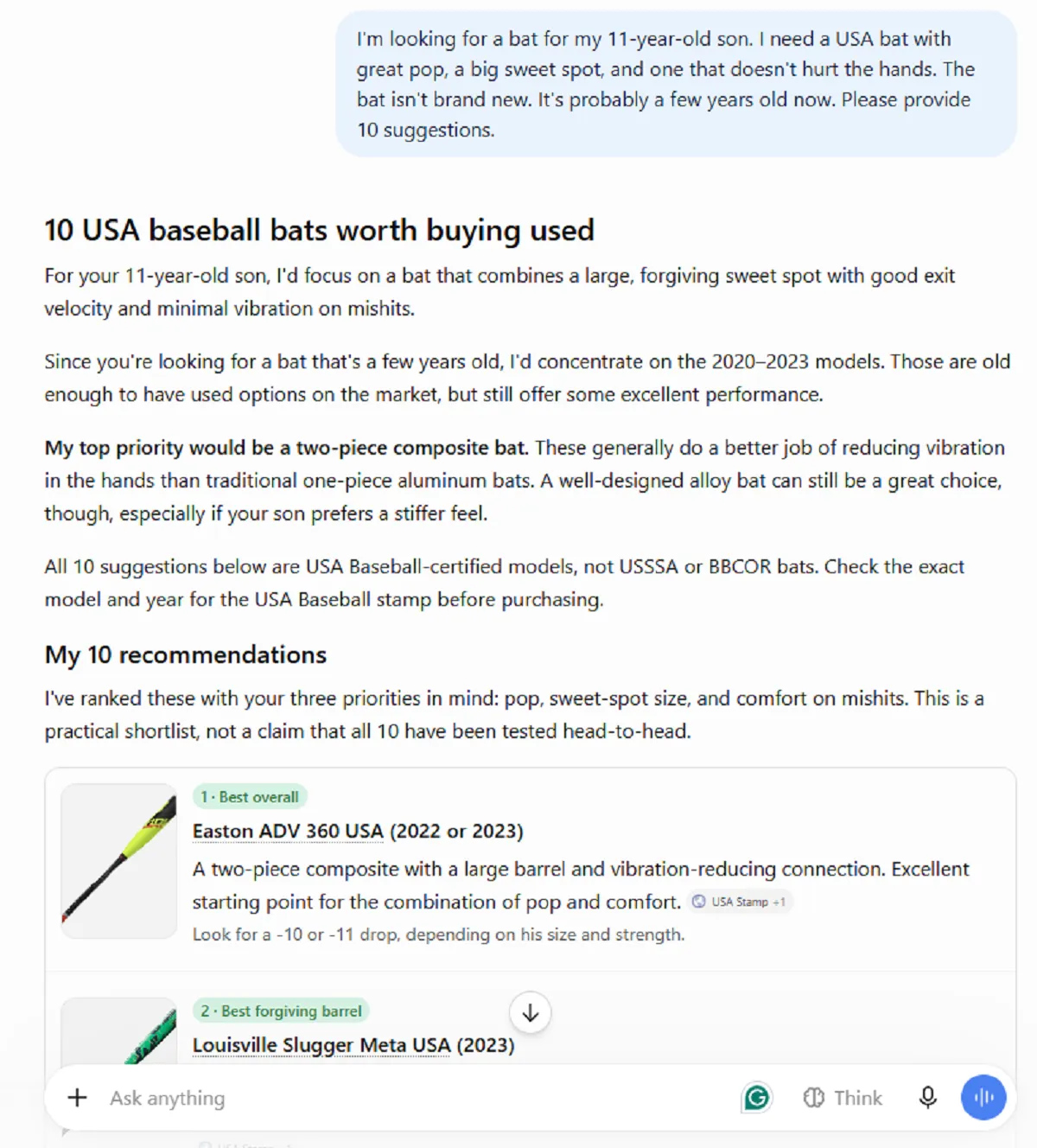
That's how I landed on the Louisville Slugger Select 719.
It wasn't new.
It wasn't trendy.
Nobody was putting it on a "Top 10 Bats of 2026" list.
It was simply an older bat with an excellent reputation.
I found one on SidelineSwap for around $70.
The Risk Nobody Talks About
Buying used bats isn't risk-free.
The biggest concern is simple:
You don't know how many swings are already on it.
Composite bats don't last forever.
Every swing adds a little wear.
That means every used bat has mileage you can't see.
So if you buy one, inspect it immediately.
Look for cracks.
Look for dents.
Look for anything unusual.
Then take it to a field.
Hit balls from a tee.
Move the tee around and hit different parts of the barrel.
Rotate the bat during testing.
Pay attention to how the ball comes off.
You're looking and listening for dead spots.
A dead spot is exactly what it sounds like. You square up a baseball and get a disappointing result anyway. Sometimes that's a sign the bat is breaking down internally.
One more thing: replace the grip.
Most used bats come with grip tape that's seen better days.
A fresh grip costs around 15 dollars and makes the bat feel brand new.
Plus, kids love choosing the colors.
The Unexpected Winner
Then something funny happened.
The cheap used bat became everyone's favorite.
My boys kept reaching for it.
The more expensive bats stayed in the rack.
The Select 719 had everything I actually cared about.
Good performance.
Manageable weight.
A generous sweet spot.
Less hand sting.
The first one lasted about a year before finally breaking.
Coincidentally, it broke shortly after my son hit a walk-off grand slam with it.
I ordered another identical one within two days.
Same model.
Same price.
No hesitation.
What I Wish Someone Had Told Me Earlier
If I could go back and talk to the version of myself standing in a sporting goods store two years ago, here's what I'd say:
Stop trying to buy more pop.
Spend that money on baseballs.
Spend it on lessons.
Spend it on a gym membership.
Spend it on gas getting to practices and games.
Because after all the research, all the purchases, and all the marketing claims, I've come to believe something that's probably bad for bat manufacturers but great for parents.
The best bat usually isn't the newest one.
It's the bat your kid swings confidently.
The bat that doesn't punish them on mishits.
The bat they'll actually want to practice with.
Sometimes that's a shiny new $400 model.
And sometimes it's a slightly beat-up bat sitting online for 70 dollars that everybody else scrolled past.
The grand slam didn't prove that the Select 719 was a magical bat.
It proved something much more useful.
I had been looking for the wrong thing all along.