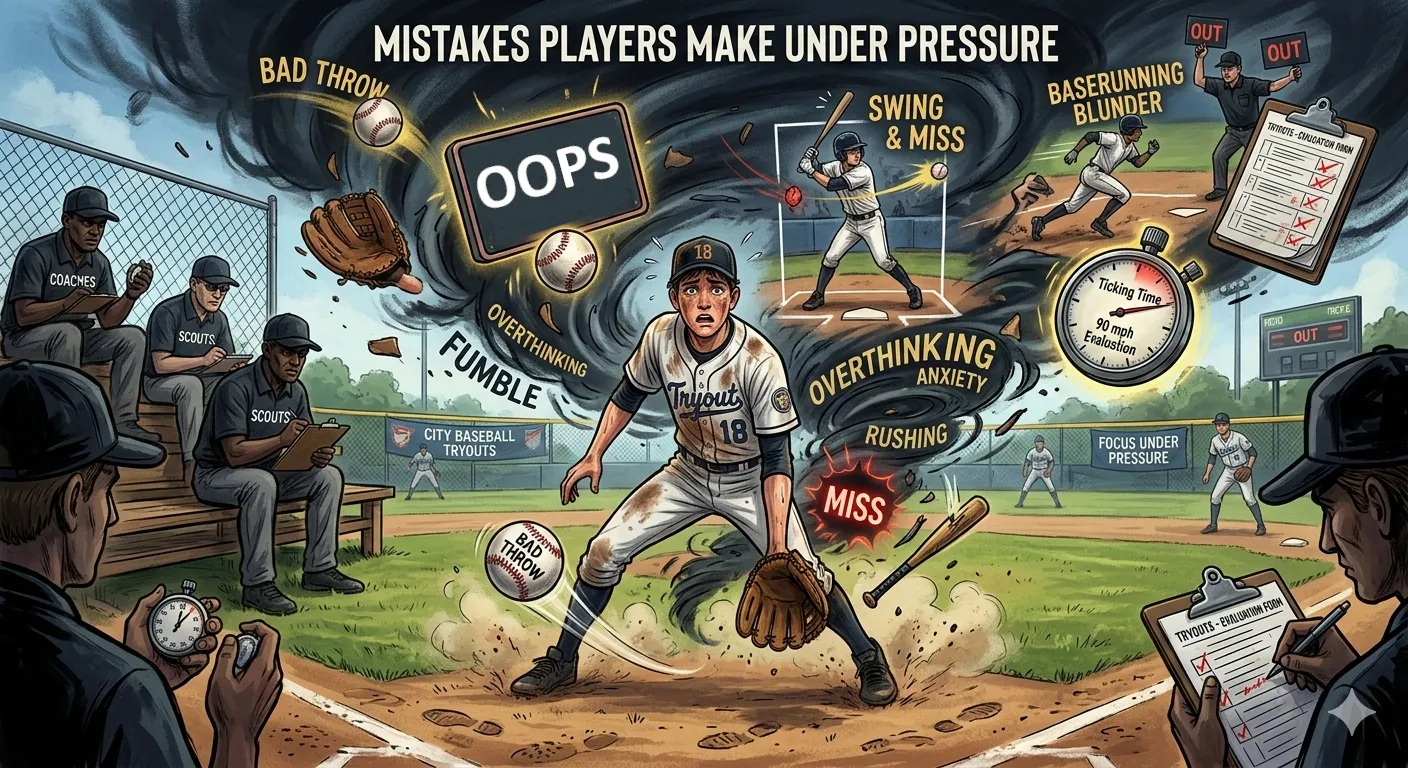
You can spot tryout pressure a mile away. The kid who usually ropes line drives suddenly can’t square up a tee ball. The footwork goes stiff. The brain starts narrating every tiny mistake like a bad sports podcast. And everyone, MLB academies, USA Baseball, your local travel coach, keeps yelling the same thing: “Relax!”
Yeah. Helpful. My son had it. Then I bought him a book. It's short, just enough to turn his game around. Here are some tips from it to help your son, too.
Tryout anxiety isn’t a flaw. It’s a predictable human response to evaluation. And baseball, for all its beauty, is absolutely brutal when it comes to evaluation. You get one swing, one throw, one 60-yard dash to show who you are.
So let’s talk about the part of tryouts nobody really teaches: how to control your head when it tries to sabotage you.
The Truth That’s Hard to Admit
Most players don’t get beaten by the competition.
They get beaten by their own breathing.
Everyone thinks performance anxiety is some personal weakness. But sports psychologists from AASP and clinical experts at the APA have been saying for years that stress narrows your focus, tightens your muscles, and wrecks timing. Tryouts magnify all of that because they mix uncertainty + judgment + comparison.
If you're feeling pressure? That means you're wired like a normal human being.
Ken Ravizza, kind of the Jedi Master of baseball mental training, used to say, “You don’t control the moment. You control your response to the moment.” This guide is basically how to build that response.
The Mental Skills Every Player Needs (But Almost Nobody Practices)
1. A pre-tryout routine that tells your brain, “We’ve been here before.”
IMG Academy teaches kids to treat routines like armor.
Not superstition. Not ritual.
Preparation.
A good routine has three pieces:
- Physical: same warm-up, same activation, same first drill.
- Focus check: one breath, one cue word (“smooth,” “quiet,” “attack”), one intention.
- Reset: something tiny to do after a mistake so you don’t spiral. Ravizza made players brush the dirt with their hands. You can tap your cleats. Doesn’t matter, consistency does.
Your brain hates uncertainty. Routines kill uncertainty.
2. Breathing that actually calms your nervous system, not the fake deep breaths everyone tells you to do.
Here’s the no-frills version that youth players pick up fastest:
- Inhale through the nose for 4 seconds
- Hold for 1
- Exhale for 6
That long exhale activates your parasympathetic system. Translation: it pulls your heart rate out of the red zone so your mechanics stop looking like you’re swinging underwater.
You don’t practice this in the car on the way to tryouts.
You practice it now, daily, until it’s automatic.
3. A realistic “pressure plan” for the moment you feel yourself tightening up
Most athletes wait until panic hits. That’s like waiting until the pitch arrives to decide what pitch you want.
Build your pressure plan ahead of time:
- Notice the cue (“I’m overthinking,” “My chest is tight,” “I’m rushing”)
- Do one breath
- Use one physical reset
- Think one simple mechanical cue (“See it,” “Glide,” “Stay tall.”)
Short. Small. Repeatable.
The brain can’t handle complexity when stressed.
4. Understand what evaluators actually look for
This one surprises people.
MLB scouts and USA Baseball evaluators will tell you privately that they don’t want perfect. They want:
- Athleticism
- Repeatable mechanics
- Competitiveness
- Emotional stability after a mistake
If you bobble a grounder, then calmly recover and make the throw?
You just earned points.
If you strike out and immediately unravel?
Everyone notices that too.
Coaches are watching your reaction more than your result.
The Hidden Psychological Traps That Ruin Tryouts
The Comparison Spiral
Tryouts stick you in a fishbowl with kids who might be bigger, stronger, or just louder about their talent. The moment you start comparing? Your working memory gets hijacked. That’s when timing goes bad.
Your goal isn’t to be better than anyone during tryouts.
Your goal is to show your version of good.
The “One Chance” Myth
Players talk like tryouts are a single coin flip that decides their future. But coaches understand variance better than players do. If you’re good, it shows across reps, across drills, across how you carry yourself.
Pressure comes from thinking everything depends on one swing.
Freedom comes from realizing no coach thinks that way.
“I have to impress them.” Nope. You have to compete.”
Impressing is egocentric.
Competing is outward-focused.
When you try to impress, you tense up.
When you compete, your mechanics return to baseline.
The Mental Game Plan (Copy This Word for Word If You Want)
Before the tryout:
- Visualize your first rep. Literally picture it. Slow and detailed.
- Pack your bag the night before (reduces cognitive load).
- Pick your cue word. Stick to it.
At the tryout:
- 4-1-6 breathing on arrival.
- One mechanical cue only.
- After every mistake: reset → breath → cue → next play.
- Watch your posture. Even a confident posture improves performance under pressure.
After the tryout (this part matters more than players think):
- Write down what you handled well, one thing you want to improve, and what you learned.
- This builds a feedback loop, so next time feels less like a mystery.
A Final Thing Nobody Says Out Loud
Tryouts are brutal because they make you vulnerable.
You want something.
You care how you look.
You don’t want to disappoint the people who believe in you.
But pressure only means you're in the game.
You’re trying.
And that’s the good stuff.
If I had to boil the whole guide into a single sentence, it’s this:
Control your breath, control your focus, control your reaction. The rest is just baseball.