All BBCOR bats are required to be a -3 drop weight, meaning the bat's weight is three ounces less than its length. A 33-inch BBCOR bat weighs 30 ounces. A 32-inch bat weighs 29 ounces.
Because the drop weight is fixed, choosing a BBCOR bat is mostly about selecting the right length.
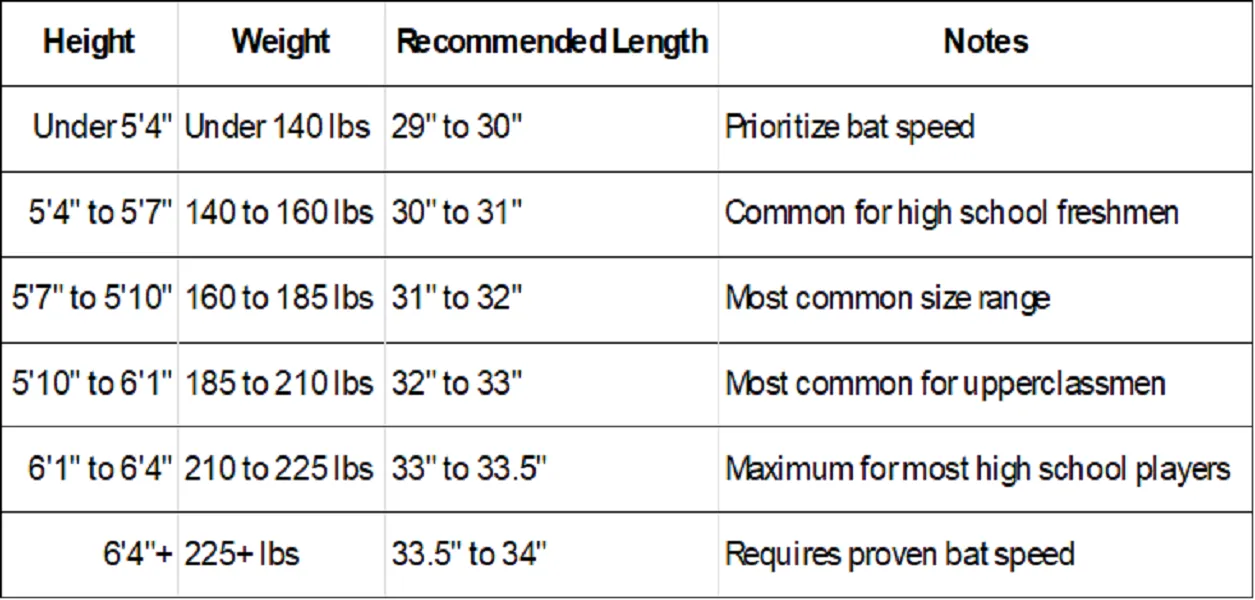
| Player Height | Player Weight | Bat Length | Bat Tip |
| Under 5'4" | Under 140 lbs | 29" to 30" | Prioritize bat speed |
| 5'4" to 5'7" | 140 to 160 lbs | 30" to 31" | Common for high school freshmen |
| 5'7" to 5'10" | 160 to 185 lbs | 31" to 32" | Most common size range |
| 5'10" to 6'1" | 185 to 210 lbs | 32" to 33" | Most common for upperclassmen |
| 6'1" to 6'4" | 210 to 225 lbs | 33" to 33.5" | Maximum for most high school players |
| 6'4"+ | 225+ lbs | 33.5" to 34" | Requires proven bat speed |
Before you pull out your credit card, remember something important.
This chart is a starting point. Not a rulebook.
I've seen 6-foot-2 hitters absolutely rake with a 32-inch bat. I've also seen smaller, stronger players confidently swing a 33-inch bat because it fit their swing perfectly. The chart gets you close. Your actual game performance makes the final decision.
One more thing. The bat size depends on the bat too. For example, you may swing a shorter Louisville Slugger Select PWR BBCOR if you're used to the Victus Vandal BBCOR. Picking the right bat length also depends on the bat. So don't be afraid to try a different bat length when you're picking the best BBCOR bat.
Why BBCOR Bat Sizing Is Different
Youth baseball players spend years choosing between -10, -8, -5, and other drop weights. Then they get to high school and suddenly every BBCOR bat is -3.
That changes everything.
When every approved BBCOR bat has the same drop weight, length becomes the biggest decision. Adding an inch doesn't just make the bat longer. It also makes it heavier.
A 31-inch BBCOR bat weighs 28 ounces.
A 32-inch BBCOR bat weighs 29 ounces.
A 33-inch BBCOR bat weighs 30 ounces.
That extra inch may not sound like much, but hitters can absolutely feel the difference when trying to catch up to a varsity fastball.
This is why many players discover a harsh reality during their first year of high school baseball. The bat they thought made them look powerful actually slows down their swing enough to hurt production.
The Biggest BBCOR Bat Myth
Let's kill a myth that refuses to die.
Longer does not automatically mean better.
Players see college hitters using 33- and 34-inch bats and assume they should swing the biggest bat possible.
Wrong.
College players often have years of strength development, elite mechanics, and the ability to generate high-end bat speed with heavier equipment.
Most high school hitters are still developing.
A slightly shorter bat swung aggressively is almost always better than a longer bat that's difficult to control.
If you're stuck between two sizes, choosing the shorter option is usually the safer decision.
Bat speed matters.
A lot.
Getting your BBCOR bat speed up can come a lot easier with the transition guide.
The Goal: The Longest Bat You Can Swing At Full Speed
Every hitter should have one goal when selecting a BBCOR bat:
Use the longest bat you can swing without sacrificing bat speed.
That's the sweet spot.
Too short, and you may lose plate coverage and some leverage.
Too long, and your swing slows down.
Too heavy, and you start cheating mechanically just to get the barrel through the zone.
The ideal bat gives you reach, barrel control, and maximum swing speed at the same time.
Simple concept. Harder to find.
That's why your hitting style matters.
Contact Hitters Should Usually Lean Shorter
Not every hitter is trying to launch baseballs over the fence.
Some players win by putting the ball in play, spraying line drives, and creating pressure on defenses.
If that sounds like you, a slightly shorter BBCOR bat may help.
Contact hitters often benefit from:
- Faster swing speed
- Better barrel control
- Improved pitch recognition
- Easier adjustment to off-speed pitches
- More consistent contact
Imagine a leadoff hitter who's 5'9" and 165 pounds.
The sizing chart might suggest 31 to 32 inches.
If that player values quick hands and line drives, the 31-inch bat may be the better choice.
Could he swing a 32?
Probably.
Should he?
Maybe not.
If the shorter bat improves timing and consistency, that's the right answer.
The box score doesn't care what size bat you use.
Power Hitters May Benefit from More Length
Now let's look at the opposite type of player.
A stronger hitter with above-average bat speed might prefer additional length.
Power hitters can benefit from:
- Increased plate coverage
- More leverage
- Slightly greater barrel momentum
- Better ability to drive balls on the outer half
A physically mature 6'1", 200-pound upperclassman could land comfortably in the 32- to 33-inch range.
If he consistently squares up pitches and maintains excellent bat speed with a 33-inch bat, there's no reason to size down.
The key phrase there is "maintains excellent bat speed."
If the bigger bat causes him to be late, the advantage disappears immediately.
Let Your Results Make the Decision
This is where bat sizing gets practical.
Forget swing tests in your living room.
Forget taking ten dry swings in a sporting goods store.
Pay attention to what happens in real games.
The baseball field tells the truth.
If You're Consistently Late
Maybe you're fouling fastballs straight back.
Maybe you're getting beat inside.
Maybe your timing always feels rushed.
A bat that is too long or too heavy could be part of the problem.
Many hitters improve immediately by dropping one inch.
That small adjustment often helps restore bat speed and improve timing.
If You're Rolling Over Ground Balls
Some hitters seem to pound everything into the ground.
When that happens consistently, they're often making contact too deep or struggling to get the barrel through the hitting zone properly.
In some cases, adding an inch of length can help improve barrel path and allow more solid contact.
Not always. But it's worth considering.
If you've been swinging a 31-inch bat and constantly hitting weak grounders despite good mechanics, testing a 32-inch model could make sense.
If You Can't Reach the Outside Pitch
A bat that's too short can sometimes limit coverage.
You'll feel like you're constantly reaching, especially on pitches away.
A slightly longer bat may help you cover more of the strike zone without sacrificing mechanics.
Again, test and evaluate.
The answer comes from results, not guesses.
Most Common BBCOR Bat Lengths
If you're wondering what most high school players use, here's a rough breakdown.
31-Inch BBCOR Bats
Popular among:
- Freshmen
- Smaller varsity players
- Contact hitters
- Middle infielders
- Players prioritizing bat speed
These bats feel quick through the zone and are often chosen by players transitioning into BBCOR for the first time.
32-Inch BBCOR Bats
The most common high school bat size overall.
Popular among:
- Sophomores
- Juniors
- Varsity starters
- Balanced hitters
- Players between 5'7" and 6'0"
The 32-inch size often represents the sweet spot between speed and power.
If you walked through a typical varsity lineup, you'd probably see more 32-inch bats than any other length.
33-Inch BBCOR Bats
Popular among:
- Strong upperclassmen
- Corner infielders
- Catchers
- Outfield power hitters
When paired with good bat speed, a 33-inch BBCOR bat offers excellent plate coverage and leverage.
34-Inch BBCOR Bats
Far less common than most players think.
These are generally reserved for:
- Very large players
- Exceptionally strong hitters
- Players with proven bat speed
Many high school athletes assume they should swing a 34 simply because professional players do.
Most would actually hit better with a 33.
Simple BBCOR Bat Length Tests
If you're between sizes, a few quick tests can help.
The Reach Test
Stand up straight and place the knob of the bat in the center of your chest.
If you can comfortably reach the barrel with your fingertips, the length is generally reasonable.
This isn't perfect, but it's a useful starting point.
The One-Hand Control Test
Hold the bat with your top hand only.
If the barrel immediately feels uncontrollable, the bat may be too heavy for your current strength and swing.
The Bat Speed Test
Take several game-speed swings.
Then compare them to a bat one inch shorter.
Which one moves through the zone faster?
Which one feels easier to control?
The answer is usually obvious.
Don't Buy Based on Growth
Parents and players make this mistake every single year.
A player measures into a 32-inch bat.
Then someone says:
"Let's buy a 33 so you can grow into it."
Bad idea.
You play baseball now.
Not next year.
A bat that's too long today can negatively affect mechanics, confidence, and production all season.
Use the size that fits your current body and swing.
When you outgrow it, then move up.
What Coaches Actually Notice
Here's something players often overlook.
Coaches don't care how big your bat is.
They care whether you can hit.
Nobody gets extra points for using a 34-inch BBCOR bat.
Coaches notice:
- Quality contact
- Barrel consistency
- Bat speed
- Plate discipline
- Competitive at-bats
The player hitting line drives with a 31-inch bat will always get more attention than the player swinging a giant bat and striking out.
Production wins.
Everything else is noise.
Final Thoughts
The best BBCOR bat length isn't the one your teammate uses. It's not the one your favorite college player swings. And it's definitely not always the biggest bat available.
Use the sizing chart as a starting point.
If you're a smaller contact hitter, err toward the shorter end of the range. If you're a larger power hitter with excellent bat speed, you may benefit from the longer end.
Most importantly, pay attention to your results.
If you're constantly late, try something shorter.
If you're struggling to drive the baseball and making weak contact, consider testing something slightly longer.
The field will tell you what works.
At the end of the day, the perfect BBCOR bat is usually simple to identify: it's the one that lets you swing aggressively, square up baseballs consistently, and step into the batter's box feeling completely confident. Everything else is just a number stamped on the barrel.