For the longest time, we chased speed the way most softball families do by hammering the arm. Strength work, long toss, more band work, more drills that made her arm feel like it had survived a small war. And for all that effort? Her MPH barely budged. Maybe 1 mph here or there. Nothing felt worth the sweat.
It was frustrating. Because she worked. She did every rep. She showed up early. She stayed late. Yet everything about her pitching screamed “I’m trying so hard,” not “This is easy power.”
So we went to an expert. An actual movement specialist who watches pitchers the way jewelers study diamonds.
She watched my daughter for maybe 30 seconds, one arm circle, one stride, one pitch, and shook her head.
“You’re training the wrong thing,” she said.
“Her arm’s not the problem. Her hips are asleep.”
Honestly? That sentence felt like a slap. A gentle one. A needed one. But still a slap.
And that’s how Band-Assisted Hip Turns crashed into our lives.
The Day We Found the Missing Power Source
I don’t know why no one tells parents this earlier: pitchers create velocity from the ground up, not the shoulder down. Hips, not arms. Rotation, not muscle.
My daughter wasn’t rotating. Not really. She was twisting a half-hearted spin that looked correct in fast motion but had no real force behind it. Like turning a doorknob instead of winding up a rubber band.
The expert handed her a resistance band and looped it around her hips.
“Pull against this,” she said. “Then turn.”
My daughter felt the resistance and BOOM.
Her hips suddenly moved with intention.
Her torso followed.
And that little delay, that tiny separation between lower body and upper body… everything changed.
Why Hip Turns Matter So Much (and why no one thinks of them soon enough)
Pitching is rotational. Everyone knows this, but almost no young pitcher trains rotation. They train the arm because it’s visible. But the hips? The hips are the engine. The ignition. The slingshot.
Band-assisted hip turns force the body to learn that:
- The hips go first
- The torso follows
- The arm whips last
That delayed chain reaction is where velocity lives. It’s sequencing, not brute strength. And once the sequence is trained properly?
The arm basically becomes the passenger, not the driver.
That was the problem we’d been missing. Her arm was doing all the work. Her hips were just “along for the ride.”
Band-Assisted Hip Turns flipped the roles.
The Muscles These Actually Hit (it’s more than people think)
Sure, you feel it in the hips. But it’s not just the hips.
These pulls train:
- Glute medius + glute max (the big stabilizers controlling rotation)
- Deep hip rotators (they’re tiny, but boy do they matter)
- Obliques (the core muscles that transfer force upward)
- Lower back stabilizers
- Transverse abdominis (which keeps the torso from collapsing)
It’s a rotational train track. You strengthen the bottom of the track first, and everything along the line starts running smoother. Her whip got faster without her arm getting stronger. And that still feels a little wild to admit.
How She Actually Does Them (the do-this-not-that version)
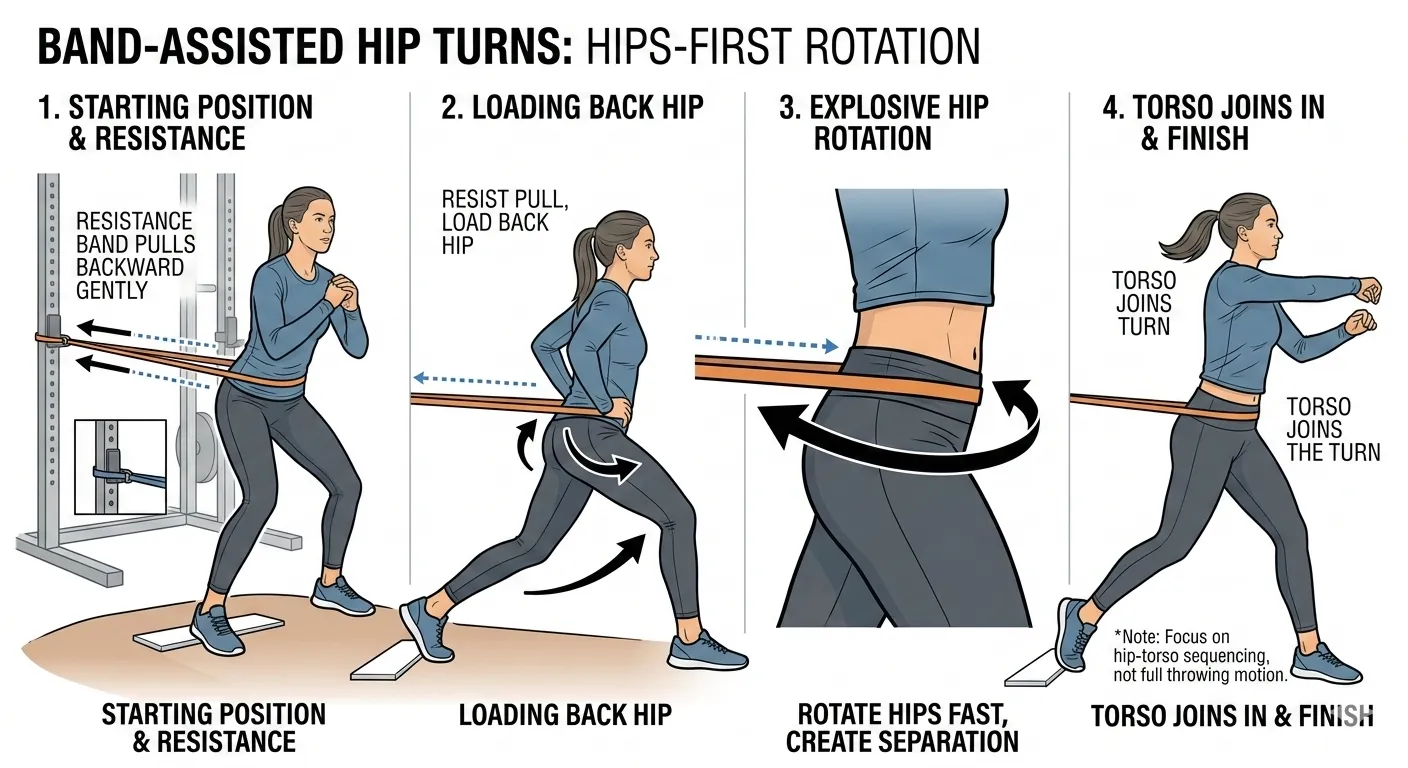
No fancy setup. Just a band looped around her hips, anchored behind her at about hip height.
Here’s the real breakdown:
- She steps forward into a pitching stance.
- The band pulls her backward gently.
- She resists the pull, loading into her back hip.
- Then she rotates fast toward her “catcher,” turning her hips explosively before her torso joins in.
No leaning.
No over-rotating.
No pretending it’s a dance move (even though she absolutely tried once).
It’s all about timing. Hips fire. Torso comes along for the ride. Arm would follow even though she doesn’t throw in this drill.
The rep teaches the sequence without the chaos of the full pitch.
What Happened Once She Did These Daily
This shouldn’t have shocked us… but it did.
Every few weeks, her velocity ticked up.
A mile per hour, then another.
Month after month, slow and steady, like a savings account finally earning interest.
Her coach asked what we changed.
Her teammates noticed she looked “snappier.”
Games started ending with her less tired, not more.
Her arm never felt heavy anymore.
Her whip got cleaner.
Her stride got stronger.
And honestly? She looked more like a pitcher in control of her power, not one guessing her way through it.
She does these daily now. Non-negotiable.
They’re the glue that holds her whole mechanics together.
Her Daily Routine (because consistency is her secret weapon)
She does these every single day.
Her coach had her start with:
- 2–3 sets
- 12–15 reps
- Light band. (The second the form gets sloppy, she switches to lighter)
- Slow tempo. Seriously, slow is where the magic happens.
- It was the consistency that made the difference, not the intensity. Every. Day.
It takes maybe three minutes total.
Three minutes that changed her arm path, her control, her confidence, basically everything that matters to a pitcher.
Check out all 5 exercises she does with bands below: