The Transaction That Reshaped American Sports
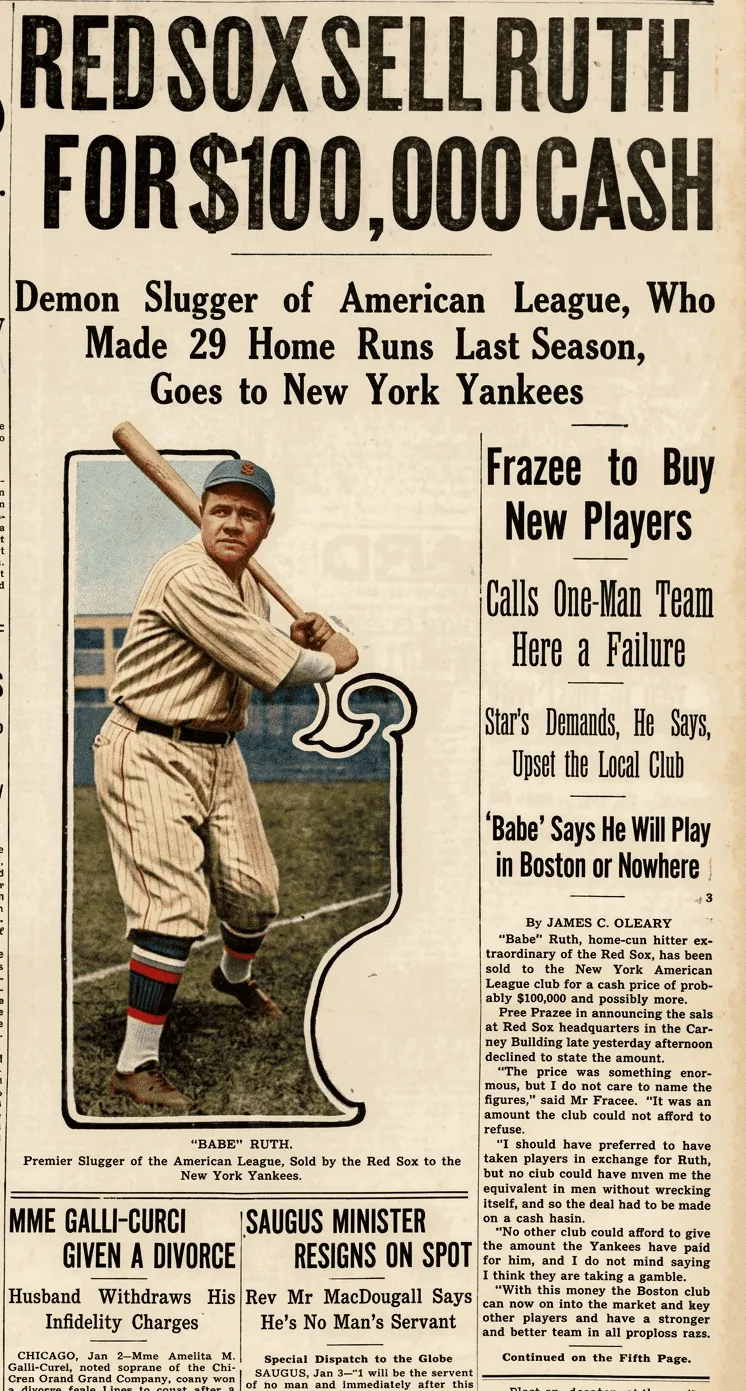
Some deals are bad. Some are disastrous. And then there's the sale of Babe Ruth from the Boston Red Sox to the New York Yankees.
More than a century later, people still argue about it. Not because it was controversial at the time, but because the consequences became almost mythological. Boston gave away the most electrifying player in baseball. New York got a superstar who transformed not only a franchise but the entire sport.
The number attached to the deal has become legendary: $100,000. At first glance, it sounds like a simple cash sale. It wasn't. The real story involves theater productions, mortgages, loans, business pressures, and one owner who desperately needed money.
The strangest part? Nobody involved could have imagined the scale of what they were setting in motion.
Harry Frazee’s Dilemma: Financing Theatrical Ventures vs. Roster Payroll
Harry Frazee has become baseball history's favorite villain.
When he purchased the Boston Red Sox in late 1916, he took over one of the strongest organizations in baseball, leading them to a World Series championship in 1918. The Yankees, meanwhile, were largely irrelevant.
Frazee's reputation suffered because of a simple narrative: he sold Babe Ruth to finance a Broadway show. Like many famous sports stories, that's only partially true.
Frazee was deeply involved in theatrical production and frequently moved money between his baseball and entertainment ventures. His finances were stretched. The Red Sox carried operating expenses, and Frazee needed liquidity. The sale of Ruth provided it.
Ironically, the musical most commonly linked to the deal, No, No, Nanette, didn't premiere until years later. The connection became part of baseball folklore because Ruth's sale helped fund Frazee's broader theatrical and real-estate interests. The details are messier than the legend, but the core fact remains: baseball considerations were not the only force driving the decision.
That's what makes the story so fascinating. Frazee wasn't evaluating advanced metrics or building for the future. He was solving a cash problem.
History rarely forgives decisions made for short-term survival.
The Deal Breakdown: Cash, Mortgages, and Fenway Park Collateral
Calling this a "$100,000 sale" actually simplifies a much more complicated arrangement.
In late December 1919, the Yankees agreed to pay $100,000 for Babe Ruth, an unprecedented amount for a baseball player at the time, with the transaction officially announced in early January 1920. But the payment structure mattered almost as much as the total.
The Yankees provided $25,000 in cash up front and financed the remainder through promissory notes. Shortly thereafter, in May 1920, Yankee owner Jacob Ruppert extended an additional $300,000 loan to Frazee, using Fenway Park itself as mortgage collateral. This financial web gave Frazee immediate access to the funds he desperately needed.
Today, sports fans think of player movements in terms of salary caps, draft picks, and multi-player trades. This sale looked more like a real-estate transaction than a modern professional sports move.
There's another overlooked detail: the Yankees weren't yet baseball royalty. Taking on a six-figure obligation plus a massive loan was a substantial gamble for the franchise.
Fortunately for New York, it may have been the best investment in sports history.
The Immediate Impact: Construction of "The House That Ruth Built"
Babe Ruth didn't merely improve the Yankees.
He changed baseball.
Before Ruth, the game's strategy centered around bunting, stolen bases, and low-scoring contests. Home runs were relatively rare. Ruth arrived in New York and started launching baseballs into places fans had never seen them go before.
In 1920, his first season with the Yankees, he hit 54 home runs. That wasn't just impressive; it was absurd. Many entire teams failed to produce that many home runs collectively.
Crowds exploded.
Ticket sales surged.
New York became baseball's biggest attraction.
Ruth's popularity generated revenues on a scale owners had never experienced. By the early 1920s, the Yankees had outgrown the Polo Grounds, where they shared tenancy with the New York Giants.
The solution was Yankee Stadium.
When the stadium opened in 1923, its identity was already tied to Ruth. The venue became known forever as "The House That Ruth Built," a nickname that captured an undeniable reality: Ruth's presence generated the money and public demand that justified its construction.
That same year, the Yankees won their first World Series championship.
The dynasty had begun.
The Cultural Divide: Boston’s Decades-Long Drought vs. New York’s Dynasty
This is where history becomes legend.
After selling Ruth, the Red Sox entered one of the most frustrating championship droughts in sports history. From 1918 until 2004, Boston failed to win another World Series.
Meanwhile, the Yankees became baseball's dominant empire.
The numbers are almost comically lopsided.
Over the decades that followed, New York won championship after championship while Boston fans endured heartbreak, near misses, and bizarre collapses. The contrast became so extreme that people invented a supernatural explanation: the "Curse of the Bambino".
Of course, curses aren't real. Management decisions are.
The Yankees consistently invested in talent, expanded their brand, and leveraged their growing financial power. The Ruth acquisition wasn't the sole reason for their success, but it served as the foundation stone.
What made the story endure wasn't just the championships. It was the emotional imbalance. Every Yankees parade seemed to remind Boston of the decision that changed everything.
Few sports narratives have produced such a clean villain, hero, and consequence.
Business Lessons: The High Cost of Selling Generational Talent
Strip away the uniforms and pinstripes, and the Ruth transaction feels surprisingly modern.
Organizations constantly face short-term pressures. Cash flow problems. Budget constraints. Investor expectations. Quarterly targets. Immediate concerns always feel urgent.
Generational talent is much rarer.
The challenge is that extraordinary people often look expensive before they look indispensable.
Frazee saw immediate financial relief. The Yankees saw a transformational asset.
In hindsight, the decision appears obvious. At the time, it wasn't. Ruth had already shown immense promise, but nobody could confidently predict he would become the most famous athlete in America and alter the economics of an entire sport.
That's the uncomfortable lesson. The biggest business mistakes aren't usually reckless gambles. They're practical decisions made under pressure.
Companies recover from bad quarters.
They don't always recover from selling their Babe Ruth.
The Transaction That Defined 20th-Century Baseball History
Once upon a time, the Boston Red Sox owned the greatest player in baseball. Every day, they benefited from his growing fame and talent. One day, financial pressures forced a choice. Because of that, Babe Ruth went to New York. Because of that, the Yankees became a powerhouse. Because of that, baseball's most enduring rivalry gained a century of emotional fuel.
The sale was worth $100,000 on paper.
Its true value can never be measured.
It helped create an American sports dynasty, fueled a mythological curse, inspired generations of fans, and transformed a regional baseball transaction into one of the most consequential business decisions ever made in sports.
A century later, owners still sell player contracts. Teams still chase short-term financial solutions. Dynasties still rise and fall.
But no transaction has cast a longer shadow than the day Boston sold Babe Ruth to New York. The money was spent long ago.
The consequences never disappeared.