The Shift from Choke-and-Slap to Pure Power
Before Babe Ruth stepped into the batter’s box, baseball was a fundamentally different game. The early 1900s were dominated by what historians call the Dead-Ball Era, a period when teams prioritized bunting, stolen bases, hit-and-run plays, and carefully placed singles. Home runs were considered accidents rather than offensive strategy. Players were taught to choke up on the bat, shorten their swings, and simply put the ball in play.
Then came George Herman “Babe” Ruth.
While his staggering home run totals transformed baseball statistically, the greater revolution may have been mechanical. Ruth pioneered many of the concepts that modern hitting instructors now emphasize: generating rotational power, creating leverage through the lower half, driving the ball in the air, and maximizing bat speed rather than merely making contact.
In many ways, Ruth was the first truly modern hitter. Long before launch angle discussions, exit velocity measurements, and advanced biomechanics laboratories, he instinctively understood the principles that power today's biggest sluggers. His swing mechanics marked a complete departure from conventional baseball wisdom and forced the sport to evolve around him.
Anatomy of the Babe Ruth Swing
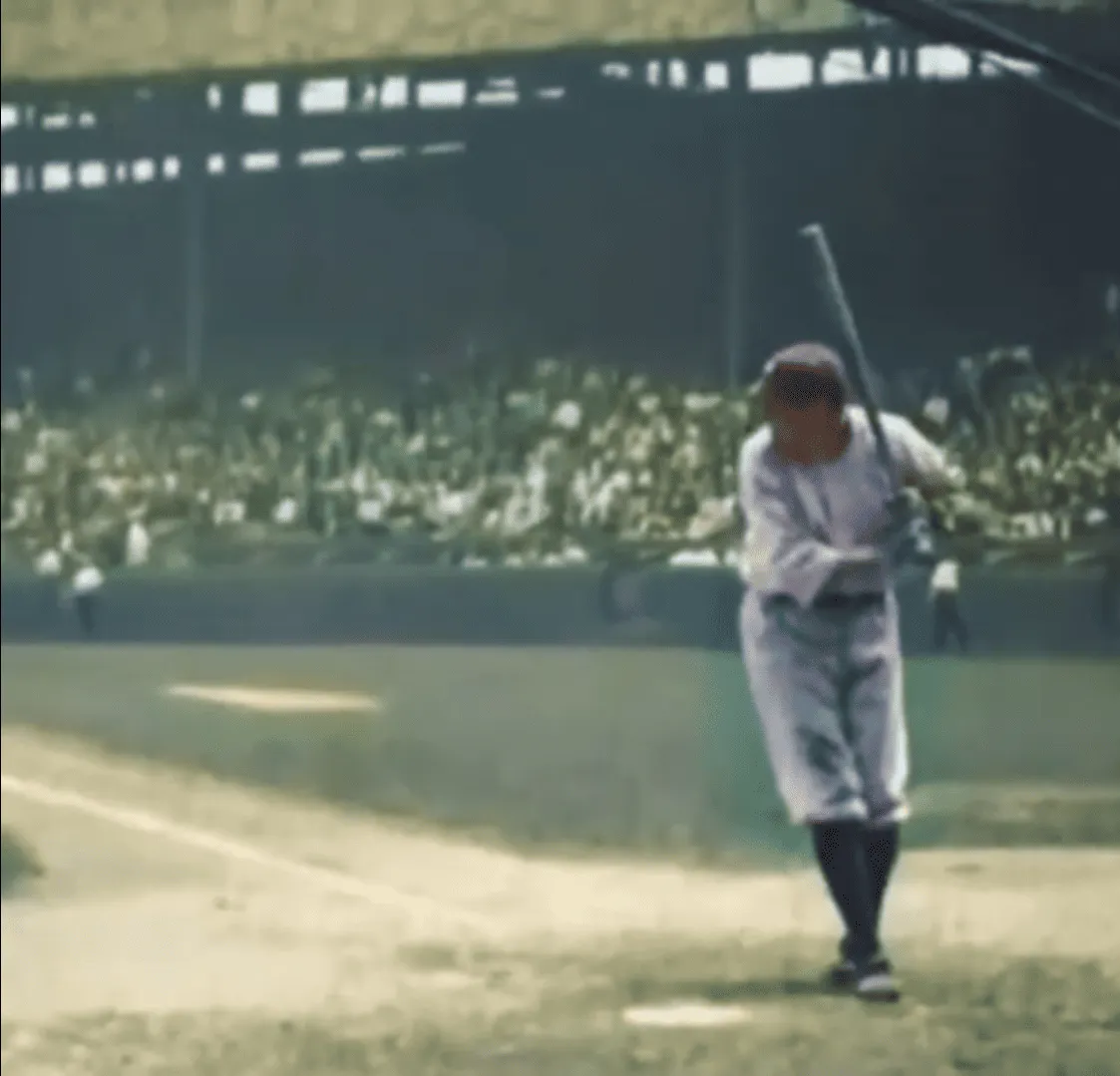
In surviving film footage, Ruth's swing looks surprisingly contemporary. While not identical to the swings seen in today's Major Leagues, the core principles remain remarkably similar.
Unlike the stiff, defensive approaches used by many players of his era, Ruth's swing featured aggressive body movement, explosive rotation, and a violent finish through the baseball. Rather than merely meeting the pitch, he attacked it with the intent of driving it as far as possible.
Several characteristics immediately stand out:
- A pronounced weight shift
- Significant lower-body involvement
- Full hip rotation
- A powerful upward bat path
- Extension through contact
- An aggressive finish
These traits form the mechanical foundation of modern power hitting.
Many of Ruth's contemporaries viewed his approach as reckless. Coaches feared the strikeouts that accompanied such aggressive swings. Yet Ruth understood a simple truth that would reshape baseball forever: extra-base hits were worth the risk.
The Open Stance and High Stride
One of the most recognizable aspects of Ruth's swing was his setup.
While many hitters of the era stood square to the pitcher with minimal movement, Ruth often employed a slightly open stance that allowed his front side to see the baseball more clearly. This positioning helped him track pitches while creating room for powerful hip rotation.
Equally important was his stride.
Ruth utilized a substantial forward move before swinging, lifting and planting his front leg in a manner that generated momentum toward the pitcher. This was not merely a timing mechanism. It served as the ignition sequence for his entire kinetic chain.
Modern hitting instructors frequently discuss the importance of gathering energy before launching the swing. Ruth instinctively understood this concept decades before sports science gave it a name.
His stride accomplished several things:
- Created rhythm and timing
- Loaded his back side
- Generated forward momentum
- Prepared his hips for explosive rotation
- Positioned his body for maximum force production
Watch footage of contemporary stars such as Aaron Judge, Shohei Ohtani, or Ronald Acuña Jr., and you'll see variations of the same principle. The specific movements may differ, but the concept remains unchanged.
Rotational Hip Mechanics and Kinetic Chain Energy Transfer
The true genius of Ruth's swing began below the waist.
Many hitters during the Dead-Ball Era relied primarily on their arms and hands. Ruth, by contrast, generated power from the ground up.
Modern biomechanics describes this sequence as the kinetic chain. Energy originates in the lower body, travels through the hips and torso, into the shoulders, down the arms, and ultimately reaches the bat barrel.
Ruth mastered this process long before anyone had high-speed cameras to explain it.
His swing began with force applied to the ground through his legs. As his front foot planted, his hips fired open explosively while his upper body remained momentarily closed. This separation between the hips and shoulders created stored rotational energy.
Today, coaches refer to this as hip-shoulder separation.
Elite hitters create tremendous torque by allowing the lower body to rotate ahead of the upper body. Ruth displayed this exact sequencing in surviving film footage. Once released, this stored energy accelerated the barrel through the hitting zone with extraordinary force. The rotational nature of his swing became one of the defining characteristics of power hitting for the next century.
What made Ruth especially dangerous was his ability to repeat this sequence despite swinging an extremely heavy bat. His immense physical strength allowed him to generate rotational acceleration that few players in history could match.
Upward Launch Angle in an Era of Downward Chops
Perhaps the most revolutionary aspect of Ruth's swing was the angle of attack.
Traditional baseball instruction during the early 1900s encouraged a downward chopping motion. Coaches believed hitters should strike the top of the baseball, producing ground balls and line drives that could be converted into base hits.
Ruth rejected this philosophy.
Rather than swinging down, he swung through and slightly upward. His bat path mirrored the incoming plane of the pitch, allowing him to lift the ball with authority. Modern analysts would describe this as creating a positive launch angle.
The goal wasn't simply to elevate the baseball. The objective was to combine elevation with power.
The results were astonishing.
In 1918, Ruth tied for the major league lead with just 11 home runs while playing partially as a pitcher.
Just three years later, in 1921, Ruth hit 59 home runs by himself.
His success demonstrated that airborne baseballs produced dramatically more offensive value than ground balls. While others focused on avoiding outs, Ruth focused on creating damage.
This shift in offensive thinking serves as one of the foundational principles behind today's launch-angle revolution. Modern power hitters spend countless hours refining attack angles designed to optimize flight distance. Ruth was doing a version of the same thing one hundred years earlier.
He recognized something most of baseball had overlooked: the shortest route around the bases is over the fence.
The Lumber: Dissecting Ruth's 40+ Ounce Heavy Bats
The modern baseball player typically swings a bat weighing between 31 and 34 ounces.
Babe Ruth's bats often weighed well over 40 ounces, with some documented game-used examples approaching or exceeding 44 ounces.
To modern players, Ruth's bat would feel more like a training device than competition equipment.
Why did he prefer such enormous lumber?
The answer lies in basic physics.
A heavier bat carries greater momentum at impact. If a hitter can generate sufficient bat speed, more mass behind the baseball produces greater force transfer. Ruth's extraordinary strength allowed him to swing these massive bats effectively. His preferred models featured large barrels that maximized striking mass while producing devastating results on well-struck balls.
There were trade-offs.
Heavy bats are more difficult to accelerate, harder to control, and less forgiving late in the swing. Most modern players sacrifice some mass for increased swing speed.
Yet Ruth's preference perfectly suited his style.
His approach emphasized:
- Maximum momentum
- Full-body rotational power
- Leveraged barrel acceleration
- Devastating contact quality
His bats became extensions of his philosophy. Everything about Ruth's game revolved around generating power.
How Ruth's Swing Forced the End of the Dead-Ball Era
Baseball did not simply evolve alongside Babe Ruth.
It evolved because of Babe Ruth.
His unprecedented offensive production changed how organizations evaluated talent, how fans consumed the sport, and how future players developed their swings.
When Ruth hit 54 home runs in 1920, he out-homered every American League team except one. The following year he hit 59 more.
The baseball world suddenly realized that a single player pursuing power could fundamentally alter a game's outcome.
Teams began seeking sluggers rather than bunt specialists. Coaches started tolerating strikeouts in exchange for extra-base damage. Ballparks increasingly celebrated home run hitters as attractions rather than curiosities.
Most importantly, young players began copying Ruth.
Generation after generation of hitters attempted to recreate his success by adopting more aggressive swings and focusing on driving the ball in the air.
This cultural shift gradually extinguished the old Dead-Ball mentality.
By the 1930s, baseball looked dramatically different from the sport Ruth had entered.
The home run had become king.
Modern Hitting Comparisons: Ruth's Swing vs. Today's Launch Angle Revolution
If Babe Ruth walked into a modern batting laboratory, many elements of his swing would receive enthusiastic approval.
Modern hitting coaches emphasize:
- Ground-force production
- Efficient kinetic chain sequencing
- Hip-shoulder separation
- Optimal attack angles
- Barrel acceleration
- Ball flight optimization
Ruth exhibited all of these characteristics.
Of course, there would be differences.
Today's hitters benefit from video analysis, biomechanical testing, velocity machines, strength training programs, and swing optimization technology. Most modern swings are shorter and more compact due to increased pitch velocity and elite breaking balls.
Yet the philosophical similarities are impossible to ignore.
Compare Ruth's approach to contemporary stars such as Aaron Judge, Shohei Ohtani, Bryce Harper, or Kyle Schwarber. The mechanics may be refined, but the underlying goal remains identical:
- Generate explosive lower-body power.
- Rotate violently through the baseball.
- Elevate the ball with authority.
- Produce extra-base damage.
These principles form the foundation of modern power hitting.
Ruth was simply decades ahead of everyone else.
In many respects, today's launch-angle revolution is not a discovery. It is a scientific validation of ideas Babe Ruth demonstrated on baseball fields nearly a century earlier.
The Original Pioneer of Modern Hitting Mechanics
Babe Ruth is often remembered for his towering home runs, larger-than-life personality, and unforgettable statistics. Yet his greatest contribution may have been mechanical rather than numerical.
He transformed the swing itself.
At a time when baseball preached caution, Ruth embraced aggression. While others focused on contact, he pursued impact. While coaches taught hitters to chop down on the ball, Ruth sought to drive it into the sky.
His open stance, forceful stride, rotational power generation, upward bat path, and commitment to maximizing damage foreshadowed nearly every major development in modern hitting instruction.
Today, baseball players train with technology Ruth could never have imagined. Analysts measure launch angle to the degree, track bat speed with sensors, and analyze kinetics frame by frame.
Yet if you strip away the technology and focus on the foundational mechanics, the blueprint remains remarkably familiar.
Long before launch angle became a buzzword, Babe Ruth was already living it.
The modern swing did not begin in a laboratory, a data center, or a professional hitting academy.
It began with the Sultan of Swat stepping into the batter's box and daring to swing harder than anyone else.