The Hall-of-Fame Pitcher Hidden Behind the Home Runs
The funny thing about Babe Ruth is that he became so famous for one thing that the world forgot he was elite at another.
It's a little like discovering Michael Jordan was also an All-Star quarterback. The feat is so ridiculous that people assume you're exaggerating.
But with Ruth, you're not.
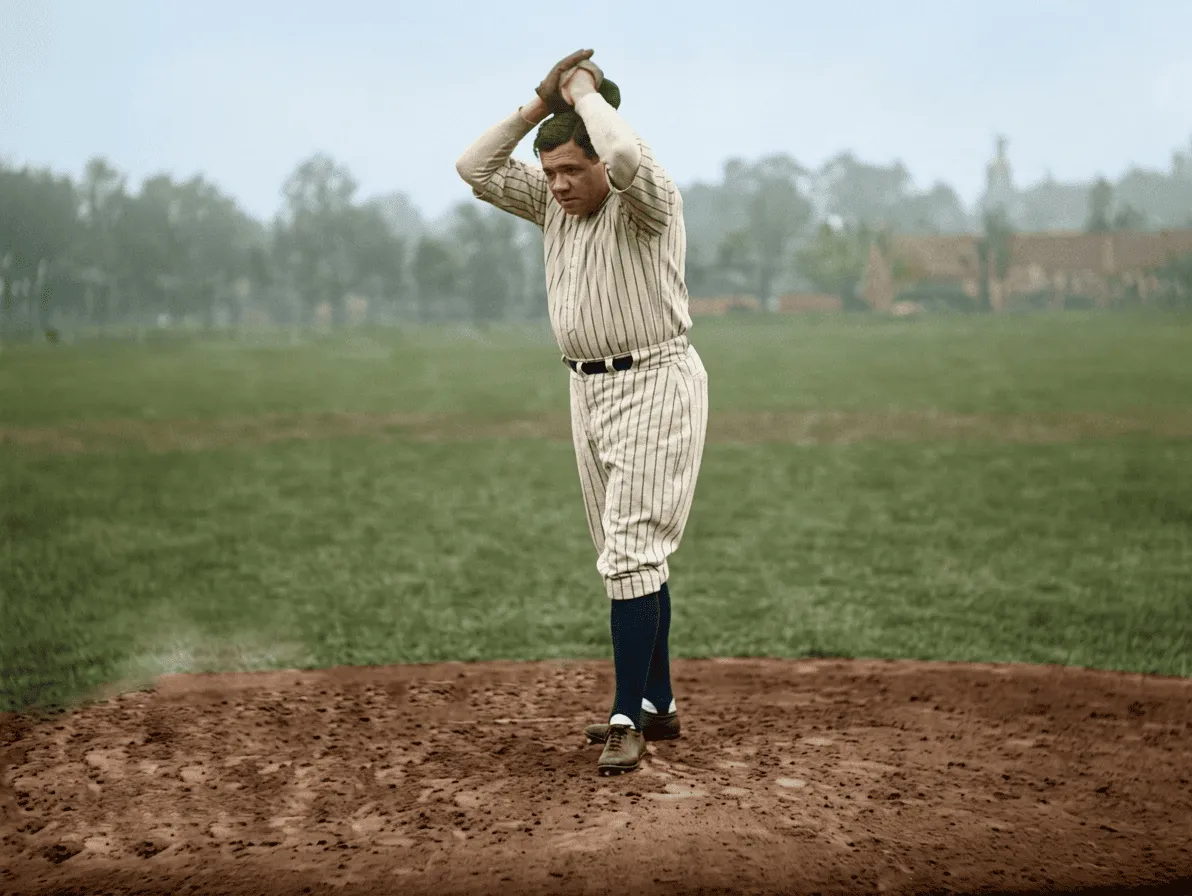
When historians talk about him, the conversation usually begins with 714 home runs. Yet for the first chapter of his career, managers looked at him and saw something completely different: a big left-handed pitcher with a fastball, a sharp curve, and nerves made of railroad steel.
If Ruth had retired before becoming baseball's greatest slugger, his pitching peak would still be remembered as one of the most dominant left-handed stretches of his era.
Granddad always loved that fact.
“People remember fireworks,” he'd say. “I admire the fuse that lit 'em.”
The Young Southpaw in Boston (1914–1917)
Back in 1914, the Boston Red Sox purchased a teenage pitcher from the Baltimore Orioles of the International League.
The kid was only nineteen.
Raw. Loud. Full of energy. Not exactly polished.
“Which,” Grandpa would laugh, “is another way of saying he was Babe Ruth.”
Boston didn't need another hitter. They needed pitching. So that's where Ruth earned his keep.
Over the next few seasons, he developed into one of the American League's most reliable left-handers. He wasn't just surviving against major-league hitters. He was dominating them.
Year after year, he learned how to set batters up, how to change speeds, how to throw strikes when pressure was squeezing everyone else.
The future home-run king was spending his days outthinking hitters one pitch at a time.
Dominating the Dead-Ball Era: Wins, ERAs, and Complete Games
Now, Grandpa always insisted you couldn't understand Ruth's pitching numbers without understanding the era.
“Different game,” he'd say. “Ball wasn't flying anywhere.”
This was the Dead-Ball Era. Home runs were rare. Strategy revolved around bunts, steals, and scratch runs.
Even in that environment, Ruth's numbers stand out.
From 1915 through 1917, he became one of baseball's workhorses:
- 18 wins in 1915
- 23 wins in 1916
- 24 wins in 1917
- Consistently elite earned-run averages.
- A staggering number of complete games.
Nowadays, a pitcher throwing seven innings gets a standing ovation.
Back then, managers expected pitchers to finish what they started.
And Ruth did.
Again.
And again.
And again.
When Boston handed him the ball, they expected the game to belong to him until the final out.
Most days, it did.
The 1916 Season: ERA Title and World Series Heroics
“Now this,” Grandpa would say, pointing a finger for emphasis, “was his masterpiece.”
In 1916, Ruth went 23–12 with a league-leading 1.75 ERA.
That number is absurd.
Even more impressive, he threw 323⅔ innings.
Modern pitchers rarely approach two hundred.
Ruth wasn't merely good in 1916. He was one of the most dominant pitchers alive.
Then came the World Series against Brooklyn.
With everything on the line, Ruth delivered a legendary 14-inning complete-game victory in Game 2.
Not nine innings.
Fourteen.
He allowed just one run and gave Boston exactly what championship teams need from their ace: certainty.
Grandpa always loved players who rose when the lights got brighter.
“You find out who a man is in October,” he'd say.
Ruth passed that test with room to spare.
World Series Pitching Legacy
Long before he terrorized pitchers in October, Ruth terrified hitters.
Across his World Series pitching appearances with Boston, he posted astonishing results.
Pressure didn't rattle him.
Crowds didn't hurry him.
Championship moments seemed to slow down for him.
The image modern fans carry is Ruth jogging around the bases after another home run.
The earlier image is just as impressive:
A broad-shouldered left-hander staring in for the sign, then firing strike after strike with a championship hanging in the balance.
That's not mythology.
That's history.
The 29⅔ Consecutive Scoreless Innings Record
Every baseball legend has one statistic that makes you stop and blink.
For pitcher Babe Ruth, this might be the one.
Between the 1916 and 1918 World Series, Ruth pitched 29⅔ consecutive scoreless innings.
Think about that.
Nearly thirty straight innings.
On baseball's biggest stage.
That record stood for 43 years until Whitey Ford finally broke it in 1961.
Grandpa loved records like that because they tell a different story than career totals.
“A hot week anybody can have,” he'd tell me. “Scoreless World Series pitching across three different autumns? That's greatness.”
How Pitching Mastery Built His Hitting Discipline
Here's the twist in the tale.
The very thing that made Ruth a great pitcher helped turn him into the greatest baseball hitter the game had ever seen.
Pitchers learn patterns.
They study weaknesses.
They understand what hitters fear and what they chase.
Ruth knew all of it because he'd spent years creating those fears himself.
When he stepped into the batter's box, he wasn't just swinging.
He was thinking like the man on the mound.
He could recognize sequences.
He could anticipate strategy.
He understood why a pitcher chose a certain pitch in a certain count.
That knowledge became an invisible advantage.
The home runs grabbed the headlines.
The pitching education helped make it possible.
The Transition Era (1918–1919): Balancing the Mound and the Outfield
Then baseball encountered a problem no manager minds having.
Babe Ruth could hit too well.
In 1918, Boston began using him more frequently in the outfield between pitching assignments.
The results were impossible to ignore.
Home runs that looked accidental at first became routine.
Pitchers around the league started discovering something unpleasant.
Ruth wasn't merely a pitcher who could hit.
He was transforming into a hitter unlike anything baseball had ever seen.
By 1919 he smashed 29 home runs, a staggering total for the era.
The sport was changing right in front of everyone.
And Babe Ruth was dragging it into the future.
Sabermetric Perspective: Re-Evaluating Pitcher Ruth with Modern WAR
Modern analytics have given historians a fresh appreciation for Ruth's pitching years.
For decades, the home-run legend cast such a giant shadow that his early accomplishments seemed almost like an interesting side note.
They weren't.
Advanced metrics show tremendous value generated from his work on the mound.
His win totals, innings load, run prevention, and postseason success compare favorably with the elite peaks of baseball's greatest pitchers.
Strip away the batting legend for a moment and examine only the pitching record.
You still find an athlete delivering seasons worthy of tremendous respect.
Maybe that's the most remarkable thing.
Most stars spend a lifetime trying to be great at one job.
Ruth mastered two.
Why Babe Ruth’s Pitching Career Alone Warranted Legendary Status
By the time Grandpa reached the end of the story, he'd usually sit back and smile.
“Here's what people miss,” he'd say.
“If Babe Ruth never became the Home Run King, he'd still be a legend.”
It sounds confusing until you think about it.
A left-handed ace.
An ERA champion.
A World Series hero.
The owner of a postseason scoreless inning record that stood for over four decades.
That's a World Series Hall-of-Fame peak.
Then, somehow, the same man reinvented himself and changed baseball forever with a bat.
That's why Ruth remains such a towering figure in sports history. Not because he succeeded at two different crafts, but because he reached an extraordinary level in both.
And that's the version of the story my grandfather loved most.
Not everybody knew the famous one.
The earlier one.
The young Boston pitcher who hadn't yet become a legend but already was.