Measuring Legendary Performance with Modern Tools
Every generation thinks it has found a better way to judge baseball players.
First, it was batting average. Then home runs and RBIs. Then came on-base percentage, OPS, WAR, Statcast, expected metrics, park adjustments, and enough spreadsheets to make an accountant cry.
The funny part? Most old legends lose a little shine when subjected to modern analysis. Their raw numbers often benefited from weaker competition, favorable conditions, or statistics that didn't tell the full story.
Babe Ruth experienced the opposite effect.
The deeper sabermetrics dig into baseball history, the more Ruth resembles a statistical anomaly. His dominance wasn't merely impressive for the 1920s. By many advanced measures, it remains unmatched across the sport's entire history.
Standardizing Context: Understanding OPS+ and wRC+
Raw statistics can be deceptive. A .320 batting average means something different in a pitcher-friendly era than it does during an offensive explosion.
That's why sabermetricians developed context-adjusted metrics.
OPS+ starts with a player's on-base percentage and slugging percentage, then adjusts for league scoring levels and ballpark effects. The scale is simple:
- 100 = league average
- 150 = 50% better than league average
- 200 = twice as productive as league average
wRC+ (Weighted Runs Created Plus) takes a more sophisticated approach by assigning proper values to every offensive event. A home run is worth more than a single, a walk has value, and everything is adjusted for league and park context.
Like OPS+, a score of 100 represents league average.
These statistics allow analysts to compare players separated by decades, even centuries, using a common language.
And that's where Ruth starts breaking the scale.
Why Ruth’s 206 Career OPS+ Tops the All-Time Leaderboard
Babe Ruth finished his career with a 206 OPS+.
That number is absurd.
Not "really good." Not "Hall of Fame level."
Absurd.
A 206 OPS+ means Ruth was 106% better than the average hitter for his entire career. Not during a peak season. Not over five years. Across 22 major league seasons.
To understand the gap:
| Player | Career OPS+ |
| Babe Ruth | 206 |
| Ted Williams | 191 |
| Barry Bonds | 182 |
| Lou Gehrig | 179 |
| Mike Trout* | 173 |
| Willie Mays | 155 |
*Active numbers can change.
The gap between Ruth and the second-place hitter is larger than the gap between many Hall of Famers and ordinary All-Stars.
Even more staggering, Ruth produced multiple seasons above 250 OPS+. Modern MVP campaigns usually land somewhere around 170 to 200.
His best offensive years weren't merely great. They existed in a different galaxy from normal greatness.
Wins Above Replacement (WAR): Combining Offense, Defense, and Pitching
WAR attempts something extraordinarily difficult.
It estimates how many wins a player contributes compared to a hypothetical replacement-level player available from the minor leagues or a bench roster.
WAR includes:
- Hitting
- Baserunning
- Defense
- Positional value
- Playing time
- Pitching contributions
No statistic is perfect, but WAR remains the closest thing baseball has to a comprehensive value measurement.
For most Hall of Famers, reaching 70 WAR virtually guarantees Cooperstown consideration. Crossing 100 WAR places a player among the greatest ever.
Ruth didn't just cross those thresholds. He shattered them.
Ruth’s 182.6 Career WAR vs. Ty Cobb, Willie Mays, and Barry Bonds
According to Baseball-Reference WAR:
| Player | Career WAR |
| Babe Ruth | 182.6 |
| Barry Bonds | 162.8 |
| Willie Mays | 156.2 |
| Ty Cobb | 151.4 |
| Hank Aaron | 143.1 |
| Ted Williams | 122.1 |
The number becomes even more impressive when you remember something casual fans often forget:
Ruth was already an elite pitcher before becoming baseball's greatest hitter.
From 1915 through 1919, he posted excellent pitching seasons, recording a 2.19 ERA with the Red Sox and ending his overall career with a 2.28 ERA across more than 1,200 career innings. Most legends accumulate WAR through a single skill set. Ruth accumulated it through two.
People often compare Shohei Ohtani to Babe Ruth, which speaks volumes. Ohtani is the first superstar in a century talented enough to make the comparison feel remotely reasonable.
Yet even Ohtani's unprecedented two-way brilliance faces a historical benchmark created by Ruth more than 100 years ago.
ERA Neutralization: Comparing 1920s League Averages to Modern Competition
One of the most common criticisms of historic players goes something like this:
"Sure, Ruth was great, but he played against weaker competition."
There is some truth there. Baseball was not integrated during Ruth's career. The talent pool was smaller. Travel, training, nutrition, and scouting looked primitive compared to today's game.
Sabermetricians acknowledge these realities.
The goal isn't to pretend 1920s baseball was identical to modern baseball. It's to ask a different question:
How dominant was Ruth relative to everyone who shared his environment?
When analysts normalize league conditions, Ruth's advantage remains extraordinary.
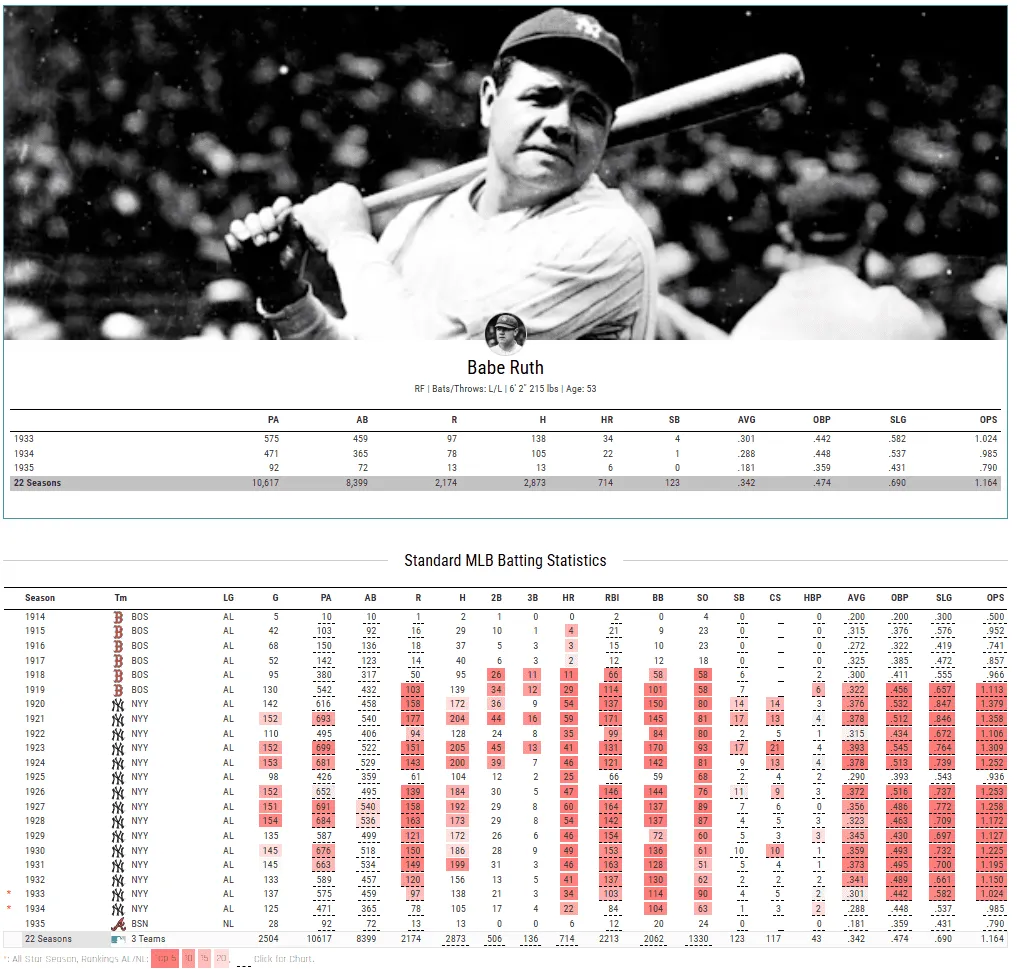
In 1920, the American League's average OPS was .738.
Ruth posted a 1.379 OPS.
That's not a gap. That's a canyon.
In many seasons, he out-homered entire teams. Not individual players. Teams.
Most eras produce a handful of stars clustered near the top. Ruth frequently stood alone.
Expected Stats: What Would Ruth’s Numbers Look Like in Modern Ballparks?
This is where things get speculative, but it's also where baseball debates get fun.
Modern expected statistics rely on exit velocity, launch angle, sprint speed, and ball-tracking technology. Obviously, those numbers don't exist for Ruth.
Still, several factors suggest his underlying skills would translate remarkably well:
- Elite Plate Discipline: Ruth led the league in walks 11 times. Modern front offices love hitters who control the strike zone.
- Legitimate Raw Power: His power wasn't fence-scraping luck. Contemporary accounts repeatedly described towering home runs that cleared stadiums by enormous margins.
- Era Dynamics: Ruth played in an era with heavier equipment, inconsistent field conditions, and fewer advantages for hitters.
Would Ruth hit 60 home runs today? Nobody knows.
Would he benefit from modern strength programs, nutrition, video analysis, and optimized swing mechanics? Almost certainly.
Some analysts suspect his raw power would remain near the top of the league regardless of era. Others believe elite velocity and specialized bullpens would reduce his production somewhat.
The safest conclusion is also the least dramatic: a player capable of producing a 206 career OPS+ in any major-league environment would probably be a superstar in every major-league environment.
The Sabermetric Consensus on Baseball’s All-Time GOAT
Arguments about baseball's greatest player rarely end. Fans of Willie Mays point to complete all-around excellence. Barry Bonds supporters highlight the most intimidating hitter the sport has ever seen. Modern fans gravitate toward players like Mike Trout or Shohei Ohtani because they've seen the talent firsthand.
But sabermetrics has a habit of cutting through nostalgia and personal preference.
When the statistics are adjusted for era, park effects, league scoring, and overall value, Babe Ruth remains the standard. His career OPS+ sits at the top of the leaderboard. His WAR total remains the highest ever recorded for a position player. His offensive separation from his contemporaries still looks almost unbelievable.
That's the part that surprises people.
Advanced analytics were supposed to make us rethink baseball history. In many cases, they did.
With Babe Ruth, they mostly confirmed it.
The legend wasn't exaggerated. If anything, the spreadsheets made it bigger.