The bat your kid loves the most will be the bat he wants to swing the most.
That might sound like a cop-out answer, but after watching a lot of 8U coach-pitch baseball, I've become convinced it's the truth. At this age, confidence matters more than bat technology. A kid who feels excited about his bat will swing it more aggressively, practice more often, and probably have more fun. And at 8U, having fun is still the whole point.
Before we get there, though, let's talk about what size bat actually makes sense.
For most 8U coach pitch players, a 27-inch, drop 10 bat is about as universally safe as equipment recommendations get. Is it perfect for every child? No. Baseball never works that way. But if a parent asked me for a blind recommendation without seeing their player, a 27" drop 10 would be my starting point nearly every time.
The reason is simple. Most 8U players are still developing strength, coordination, timing, and mechanics. A 27-inch bat gives them enough reach without becoming difficult to control. A drop 10 weight typically keeps the bat light enough that they can swing it quickly and consistently.
And honestly, bat speed is usually the biggest issue at this age.
Not power.
Not barrel technology.
Not whether the bat was endorsed by a major leaguer.
Just bat speed.
A kid who can get the barrel through the hitting zone on time will outperform a kid swinging a heavier, more expensive bat almost every weekend.
That's why when parents ask, "What's the best bat?" I usually start by asking, "What can your kid actually swing comfortably?"
Because that's the real question.
First Things First: Check Your League's Certification Requirements
Before you buy anything, find out what bats your league allows.
This sounds obvious, but every year parents spend good money on a bat only to discover it can't be used in games.
Many coach pitch leagues require specific certifications. Some allow USA Baseball bats. Others may allow USSSA bats. Some leagues have additional local rules on barrel diameter, composite construction, or bat length.
The good news is that finding the required certification is usually easy.
Check:
- Your league rulebook
- Registration documents
- The league website
- Your coach
- League administrators
Don't assume.
A bat can be perfectly legal for one organization and completely illegal for another.
Nothing is more frustrating than showing up on Opening Day with a shiny new bat and being told it has to stay in the dugout.
Always verify the certification requirement first. Then start shopping.
How to Determine the Right Length
Parents often focus on weight, colors, brands, and marketing claims. Length should come first.
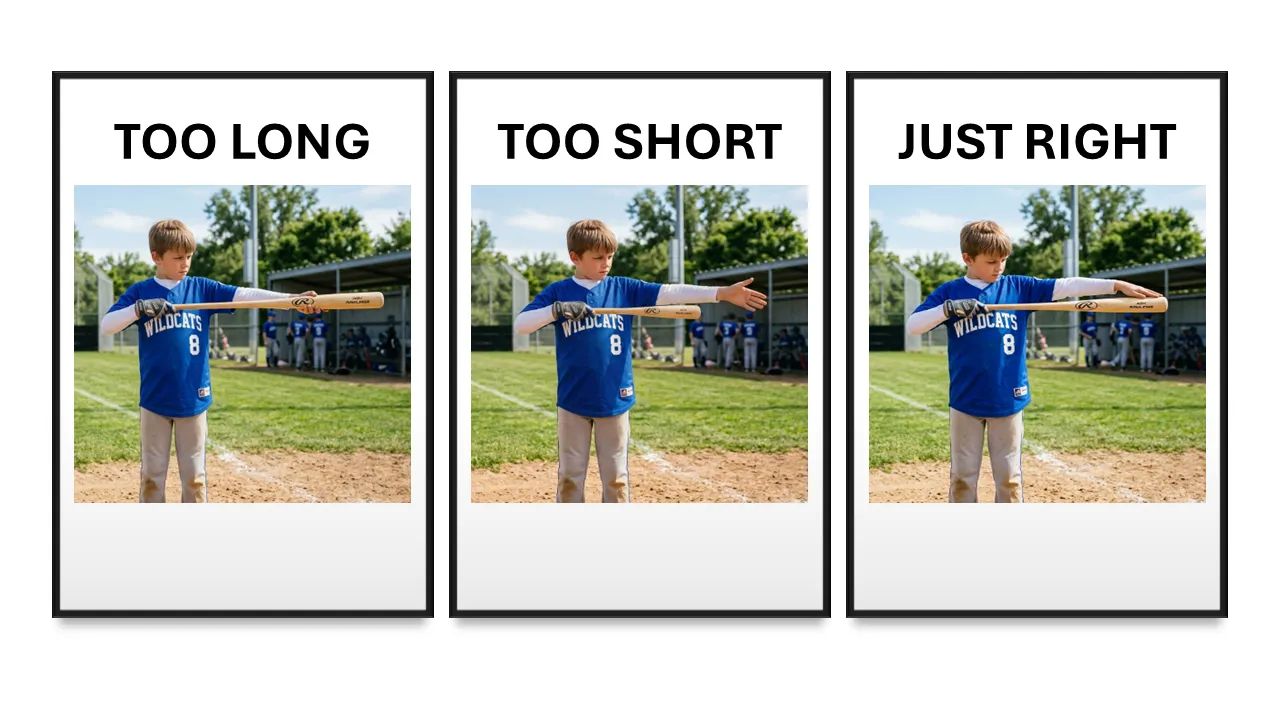
One of the simplest measurements for younger players is having the player hold their arm out to the side and measuring from roughly the middle of the chest to the fingertips.
For most 8U players, that measurement lands somewhere around the 26-inch to 28-inch range. Not surprisingly, that's exactly why 27 inches sits right in the sweet spot.
It's not a perfect science.
There isn't a magical formula that guarantees success.
Kids grow at different rates. Some are tall and skinny. Others are compact and strong. Some have unusually long arms. Some have unusually short arms.
But as a starting point, the chest-to-fingertip method works remarkably well.
If you're torn between two lengths, I generally lean toward the shorter option at this age.
Why?
Control.
A slightly shorter bat is usually easier to swing properly than a slightly longer one.
And proper swings create better habits.
Why Lighter Is Usually Better
This is probably the biggest mistake I see.
Parents assume bigger kids need heavier bats.
Sometimes that's true.
Most of the time at 8U, it isn't.
Watch a youth baseball game, and you'll notice something. The kids who consistently make solid contact aren't necessarily the biggest kids on the field. They're usually the ones who get the bat through the zone quickly.
Fast bats win.
Especially in coach pitch.
Remember what's happening during a typical at-bat. The coach is throwing hittable pitches. The objective isn't to hit a 350-foot home run. The objective is to make clean contact and put the ball in play.
A lighter bat helps accomplish that.
When bats are too heavy, several problems appear quickly:
- Slower swing speed
- Late contact
- Weak swings
- Poor mechanics
- One-handed finishes
- Kids getting tired during games
You can see it happen.
The kid starts the game looking fine. By the fourth inning, the bat suddenly feels like a tree trunk.
That's not helping anyone.
A lighter bat allows a player to stay athletic, maintain good mechanics, and swing aggressively.
At 8U, aggressive swings are usually a great thing.
The Myth of the "Power Bat"
Parents love the idea of power.
Equipment companies know this.
That's why every season brings a new round of marketing designed to convince everyone that this year's bat is going to unlock hidden performance.
The reality is much less exciting.
At 8 years old, the biggest factor in hitting success isn't bat technology.
It's making contact.
Think about the best hitters in your local coach pitch league.
Most aren't succeeding because they found a magical bat.
They're succeeding because they:
- Swing often
- Practice regularly
- Keep their eyes on the ball
- Have decent timing
- Swing confidently
Those skills matter infinitely more than whether a bat costs $80 or $400.
That's not a popular answer, especially in the sporting goods industry.
It's still true.
Expensive Bats Usually Don't Make a Big Difference at 8U
Let's talk about money for a moment.
Every parent wants to help their kid succeed. That's completely understandable.
The problem is that youth baseball can become an endless equipment race.
One family buys a premium bat.
Another family buys an even more expensive bat.
Soon people start wondering if they're holding their kid back without the newest model.
At 8U coach pitch, that concern is mostly unnecessary.
Your child is still learning basic movement patterns.
They're figuring out timing.
They're learning how to track pitches.
They're discovering how to handle success and failure.
A premium bat can't do any of those things for them.
Will a high-end bat perform well?
Sure.
Will it perform hundreds of dollars better than a reasonably priced option?
Probably not.
Not at this age.
I would much rather see parents spend money on:
- Backyard practice balls
- A batting tee
- Extra field time
- Lessons, if desired
- Family catch sessions
Those things tend to have a much bigger impact.
Confidence Is a Real Performance Enhancer
Now let's come back to where we started.
The bat your kid loves the most will be the bat he wants to swing the most.
This matters more than people realize.
Kids form equipment attachments.
Maybe it's the color.
Maybe it's the graphic design.
Maybe a teammate uses one.
Maybe it just feels cool.
Adults tend to dismiss these reasons because they aren't logical.
But baseball isn't played by robots.
Confidence matters.
If a player walks into the batter's box believing he has a bat he likes, he's already in a better mental place.
I've watched kids hit rockets with average bats because they loved them.
I've watched kids struggle with elite bats because they hated how they felt.
The confidence factor is real.
Especially at 8 years old.
Don't Chase Tiny Advantages
One thing youth sports teaches parents is that there are always tiny advantages available for purchase.
A newer bat.
A lighter bat.
A different barrel.
A newer technology.
A limited edition model.
The problem is that chasing tiny advantages often distracts from the important things.
At 8U coach pitch, the major advantage isn't equipment.
The major advantage is getting swings.
Lots of swings.
A player who takes 500 quality practice swings with a decent bat will almost always outperform a player who takes 100 swings with the hottest bat on the market.
Practice beats equipment.
Repetition beats technology.
Confidence beats marketing.
That's not as exciting as buying new gear, but it's usually how young players improve.
So What Bat Should You Buy?
Here's the practical approach I recommend.
First, confirm your league's certification requirements.
Second, look for a bat around 27 inches and drop 10 unless your player's size suggests otherwise.
Third, prioritize lighter options over heavier ones.
Fourth, don't convince yourself that the most expensive bat is necessary.
Then do something surprisingly simple.
Set a budget.
Maybe that's less than $100.
Maybe it's $75.
Maybe it's $150.
Whatever feels reasonable for your family.
Once you've established that price range, narrow the choices to bats that meet your league requirements and fit the player appropriately.
Then let your kiddo pick.
Seriously.
Let him choose the one he thinks looks cool.
The one with the colors he likes.
The one that feels good in his hands.
The one he's excited to bring to practice.
Because at 8U coach pitch, the goal isn't to find the perfect bat. The perfect bat doesn't exist.
The goal is to find a bat that's the right length, light enough to swing well, approved by the league, and exciting enough that your child wants to pick it up every chance he gets.
That's the bat that will get used.
That's the bat that will get practice swings.
That's the bat that will build confidence.